
Abstract
The internet has become an essential part of everyday life and plays an important role in the exercise of constitutional rights. During public protests, however, governments sometimes suspend internet services to maintain public order and national security. This article examines whether such shutdowns are consistent with the constitutional principles of legality, necessity, proportionality and accountability. It discusses India’s legal framework on internet shutdowns, including the Supreme Court’s decision in Anuradha Bhasin v. Union of India, and examines the human impact of prolonged digital blackouts through examples from Jammu and Kashmir, Manipur and recent protests in New Delhi. The article argues that blanket internet shutdowns increasingly operate as “silent curfews” because they restrict communication, education, healthcare, business and democratic participation without physically restricting movement. It concludes that India should adopt a more balanced constitutional approach based on transparency, independent review and targeted alternatives that protect both public order and fundamental freedoms in the digital age.
India is no longer just a digitally connected country because the internet has now become an essential part of everyday life. With more than 1.03 billion internet users, around 500 million active social media users[i] and the second-largest internet market in the world, the internet has become an essential part of everyday life[ii]. Over the years, people have gradually moved from newspapers and television to digital platforms for information, public discussions, and staying updated with current events. Today, the internet is not used only to communicate with others. It has become the gateway to education, healthcare, banking, UPI payments, government services, employment opportunities and real-time news. More importantly, digital platforms have become the new public square where people express their opinions, discuss public issues, organise peaceful protests and participate in democratic life.
In today’s digital world, an internet shutdown is much more than just suspending internet or telecommunication services, because it cuts people off from essential services, communication and access to information. As a result, it affects not only how people connect with one another but also how they participate in public life. At the same time, the State has a constitutional duty to maintain public order and protect national security. However, the growing use of internet shutdowns during public protests raises an important constitutional question: Can a democratic government maintain public order by restricting the very digital spaces where people exercise their democratic rights?
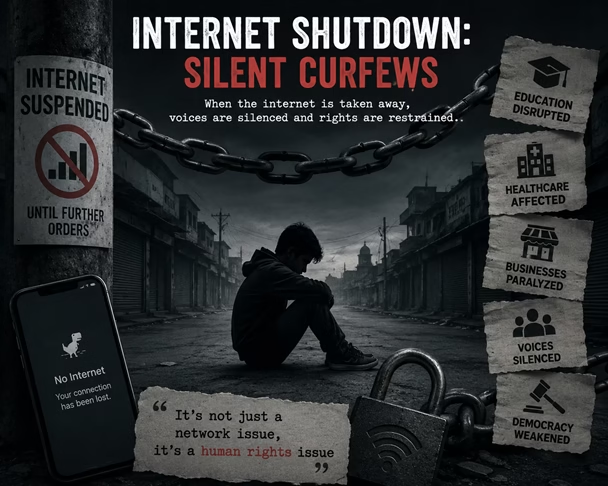
This constitutional question becomes even more important because India continues to record one of the highest numbers of internet shutdowns among democratic countries.[1] That is why internet shutdowns should not be seen only as administrative decisions. They should also be understood as “silent curfews” because, although they do not physically stop people from leaving their homes, they quietly restrict communication, access to information, business activities and the exercise of constitutional rights. Therefore, the real concern is not whether the Government has the power to impose internet shutdowns, but whether that power is exercised in accordance with the constitutional principles of legality, necessity, proportionality and accountability.
When Public Order Meets Constitutional Freedom
Maintaining public order is essential in every constitutional democracy, but it must go hand in hand with protecting the fundamental rights of citizens. The Constitution of India also recognises that these rights are not absolute and may be reasonably restricted in certain situations. Under Article 19(2), the State can impose reasonable restrictions on the freedom of speech and expression in the interests of public order, the sovereignty and integrity of India and the security of the State. Similarly, Article 19(3) permits reasonable restrictions on the right to assemble peacefully. These constitutional provisions recognise that the Government must have the authority to respond to genuine emergencies. However, having such authority does not mean that it can exercise these powers without constitutional limits or judicial scrutiny.
At present, internet shutdowns in India are regulated by the Telecommunications Act, 2023[iii] and the Telecommunications (Temporary Suspension of Services) Rules, 2024[iv], which allow the Government to temporarily suspend telecommunication services in specific situations. However, in a country where people depend on the internet for almost every aspect of daily life, shutting down internet services affects much more than online communication. It directly impacts Article 19(1)(a), which guarantees the freedom of speech and expression, Article 19(1)(b), which protects the right to assemble peacefully and Article 21, which guarantees the right to life and personal liberty. In today’s digital age, these rights are closely linked to access to education, healthcare, employment, essential government services and even access to justice through digital platforms.
The Supreme Court[2] dealt with these concerns in the landmark case of Anuradha Bhasin v. Union of India, 2020[v],the Court held that internet shutdowns cannot continue for an indefinite period and made it clear that every shutdown order must be necessary, proportionate, published and reviewed regularly. It also observed that administrative convenience cannot take the place of constitutional discipline. At the same time, the Court did not take away the Government’s power to suspend internet services. Instead, it clarified that such powers must always be exercised in accordance with the rule of law and within constitutional limits. Therefore, the real debate is not whether internet shutdowns should exist, but whether they are imposed in a manner that respects the democratic values and constitutional principles the Constitution seeks to protect.
The Human Cost Behind Digital Blackouts
An internet shutdown affects much more than social media or online communication because it disrupts many parts of everyday life. In a country where people depend on the internet for almost everything, even a temporary shutdown can cause serious problems. A student may miss online classes, a patient may not be able to consult a doctor through telemedicine, a small business owner may lose UPI payments and a journalist may find it difficult to verify or report important information. It can also make it harder for people to contact their families or seek help during emergencies. Although internet shutdowns are often imposed as a temporary measure to maintain public order, their social and economic impact is felt by millions of ordinary people who have no connection with the protest or disturbance that led to the restriction.
India’s experience over the last decade clearly shows how far-reaching the impact of internet shutdowns can be. After the abrogation of Article 370 on 5 August 2019, Jammu and Kashmir[vi] witnessed one of the longest internet shutdowns ever imposed in a democratic country. The prolonged restrictions affected education, healthcare, businesses, journalism and even access to legal services. These events later led to the Supreme Court’s landmark judgment in the case of Anuradha Bhasin. A similar situation was seen in Manipur[vii] in 2023, where prolonged internet restrictions during ethnic violence disrupted humanitarian relief, made it difficult for families to stay in touch, affected online education and limited media reporting. More recently, during the July 2026 protests near Jantar Mantar[viii] in New Delhi, the temporary suspension of mobile internet services reportedly disrupted digital payments, caused inconvenience to commuters and local vendors and limited the ability of journalists and protesters to communicate in real time. These examples show that the impact of internet shutdowns goes far beyond maintaining public order because they also affect the everyday lives of ordinary people.
These incidents are not isolated examples but part of a much larger pattern. According to Access Now, India recorded 771 internet shutdowns between 2016 and 2023, the highest number among democratic countries. This raises an important constitutional question. If digital platforms have become the primary space for communication, businesses, education and democratic participation, then frequent internet shutdowns cannot be treated as mere technical or administrative decisions. Instead, they increasingly resemble silent curfews. Although they do not physically stop people from leaving their homes, they significantly restrict their ability to communicate, access information and participate in modern democratic life.
Reimagining Constitutional Limits In The Digital Age
The debate over internet shutdowns is not about choosing between national security and individual liberty because both are essential in a constitutional democracy. The real challenge is to ensure that efforts to maintain public order do not unnecessarily restrict the very constitutional freedoms they are meant to protect. As India continues to strengthen its digital infrastructure through initiatives such as Digital India, its legal and administrative approach must also keep pace with these changes. Internet shutdowns, once seen as a convenient administrative response, are becoming increasingly difficult to justify in a society where people depend on digital connectivity for education, healthcare, businesses, government services and democratic participation.
A more balanced constitutional approach is to treat internet shutdowns as an exceptional measure rather than a routine response. Before suspending internet services across an entire region, the authorities should first consider whether less restrictive alternatives can effectively address the security threat or public order concerns. These may include blocking specific unlawful content, restricting access to particular digital platforms in accordance with the law, strengthening fact-checking mechanisms or taking targeted action against those responsible for inciting violence. Such measures would allow the State to address genuine security concerns while reducing unnecessary disruption to the rights and everyday lives of ordinary citizens.
Transparency and accountability must also be part of any constitutional framework governing internet shutdowns. Every shutdown order should be published promptly and should clearly explain its legal basis, geographical scope, duration, and why less restrictive measures were considered insufficient. The orders should also be reviewed independently at regular intervals to ensure that such extraordinary powers are exercised only when they are genuinely necessary. At the same time, essential digital services such as hospitals, emergency response systems, banking networks and critical government services should continue to function wherever technically possible, so that measures taken to maintain public order do not unnecessarily affect public welfare.
As technology continues to evolve, the constitutional challenges surrounding internet shutdowns are also becoming more complex. Artificial intelligence, deepfakes, encrypted messaging platforms and rapidly spreading online misinformation can make it more difficult for governments to maintain public order. However, these developments also show why blanket internet shutdowns are becoming increasingly difficult to justify. A digitally advanced nation should respond to digital threats with equally advanced legal and technological measures rather than disconnecting millions of people who have no involvement in the situation. Ultimately, constitutional governance is measured not by how much power the executive possesses, but by how carefully and responsibly that power is exercised in accordance with the rule of law.
Conclusion
The discussion on internet shutdowns is no longer limited to technology because it is now closely linked to constitutional rights and democratic governance. People rely on digital platforms to express their opinions, organise peaceful protests, access government services, pursue education, run businesses and take part in public discussions. As a result, an internet shutdown during public protests is much more than a technical interruption because it can affect several constitutional freedoms at once. While the State has a responsibility to maintain public order and national security, these objectives should not be pursued by treating digital connectivity as something that can be withdrawn without strong constitutional justification. The Supreme Court’s decision in Anuradha Bhasin reaffirmed that executive power must always be exercised in accordance with the principles of legality, necessity, proportionality and accountability. As India becomes increasingly digital, these constitutional safeguards should guide every decision to suspend internet services. Internet shutdowns may remain available as an exceptional response to genuine emergencies, but they should never become a routine administrative practice. After all, the true strength of a constitutional democracy lies not in its ability to disconnect its citizens during moments of crisis, but in its ability to protect public order without sacrificing fundamental freedoms. Otherwise, digital blackouts risk becoming silent curfews-restrictions without physical barriers that nevertheless weaken the constitutional promise of liberty, democratic participation and the rule of law.
[i] DataReportal, Digital 2026: India (Singapore: Kepios, 2026) https://datareportal.com/reports/digital-2026-india
[ii] Statista, Countries with the Largest Number of Internet Users (Hamburg, Germany: Statista GmbH, 2026) https://www.statista.com/statistics/262966/number-of-internet-users-in-selected-countries/
[iii] Telecommunications Act, No. 44 of 2023, ss 20–21, w.e.f. 26 June 2024
[iv] Telecommunications (Temporary Suspension of Services) Rules, 2024, notified vide G.S.R. 443(E), Ministry of Communications, 26 June 2024.
[v] Anuradha Bhasin v Union of India (2020) 3 SCC 637
[vi] Human Rights Watch, India: Restore Kashmir’s Internet, Phones (New York, 28 August 2019) https://www.hrw.org/news/2019/08/28/india-restore-kashmirs-internet-phones
[vii] Access Now, Shrinking Democracy, Growing Violence: Internet Shutdowns in 2023 (New York, 2024) https://www.accessnow.org/press-release/india-keepiton-internet-shutdowns-2023-en/
[viii] ‘Govt Ordered Mobile Internet Shutdown till 6 pm around Jantar Mantar’ Hindustan Times (New Delhi, 20 July 2026) https://www.hindustantimes.com/india-news/govt-ordered-mobile-internet-shutdown-till-6-pm-around-jantar-mantar-101784553569975.html

Leave a Reply