
Abstract
This article critically interrogates the structural relationship between caste hierarchy and Indian constitutionalism through the analytical lens of Critical Legal Studies (CLS). While the Constitution of India, forged in the transformative imagination of B.R. Ambedkar, promised a thoroughgoing rupture with hereditary social subordination, the institutional practice of Indian law has frequently reproduced the very hierarchies it ostensibly dismantles. Drawing on the theoretical resources of Duncan Kennedy, Roberto Unger, Upendra Baxi, Marc Galanter, Kimberlé Crenshaw, and Gopal Guru, the article examines how judicial indeterminacy, the ideology of merit, the formal neutrality of constitutional interpretation, and the social composition of legal institutions together constitute a structural machinery for caste perpetuation. Through doctrinal analysis of landmark cases, including Indra Sawhney v. Union of India, Subhash Kashinath Mahajan v. State of Maharashtra, Safai Karamchari Andolan v. Union of India, and Janhit Abhiyan v. Union of India, the article demonstrates how rights discourse can simultaneously extend symbolic legitimacy and foreclose substantive transformation. The article concludes by sketching an alternative, Ambedkarite-decolonial jurisprudence oriented toward structural justice rather than formal equality.
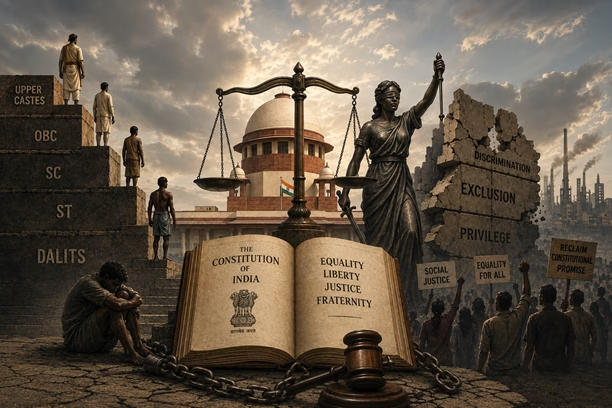
The Constitution of India, adopted on 26 November 1949, represents one of the twentieth century’s most ambitious experiments in juridical social transformation. Its architecture was conceived not merely as a charter of negative liberties against an overbearing state, but as an affirmative instrument of societal reconstruction, a “transformative constitution,” in the lexicon of contemporary constitutional theory, that sought to dismantle entrenched structures of social domination and usher in a more egalitarian public order. At the heart of this transformative project was the caste system: a millennia-old apparatus of graded inequality, exclusion, and humiliation that Babasaheb B.R. Ambedkar, the Constitution’s principal architect, characterised, with characteristic precision, as a “system of graded sovereignty” in which each stratum oppresses the one below it while remaining subordinate to the one above.
Seven decades on, however, the lived reality of caste in India presents a dissonant counterpoint to constitutional promise. Dalits continue to face systematic exclusion from educational institutions, public employment, and social spaces. The practice of manual scavenging, perhaps the most visceral emblem of caste-based degradation, persists despite legislative prohibition and judicial intervention. Upper-caste dominance in the judiciary, the civil services, and elite legal education remains deeply entrenched. The jurisprudence on reservation has oscillated between grudging acknowledgment and doctrinal containment. In short, the constitutional text and the caste-inflected social text operate in a condition of chronic tension, a tension that is not incidental to the legal order but, this article argues, is reproduced by it.
This article approaches that tension through the conceptual framework of Critical Legal Studies (CLS), the American jurisprudential movement that emerged in the late 1970s as a radical internal critique of liberal legalism. CLS insists on the indeterminacy of law, the proposition that legal materials underdetermine outcomes and that judicial choices are therefore political rather than technical. It further holds that law is ideologically embedded: legal doctrine systematically obscures and legitimates existing distributions of social power even as it professes neutrality and universality. These insights, I argue, translate with remarkable fidelity to the Indian constitutional context, where the formal vocabulary of equality, dignity, and fundamental rights has often served to stabilise rather than unsettle caste hierarchy.
The central research question animating this article is: in what specific ways do Indian courts, constitutional interpretation, and rights discourse reproduce caste hierarchies despite the transformative mandate of the Constitution? The answer is pursued through three inter-related analytical moves: first, an examination of judicial ideology and the myth of caste-blind adjudication; second, a doctrinal scrutiny of reservation jurisprudence, SC/ST Act cases, and manual scavenging litigation; and third, a structural analysis of institutional composition, epistemic dominance, and the symbolic function of rights. The article concludes by sketching an alternative jurisprudence grounded in Ambedkarite constitutional philosophy, decolonial legal theory, and the demand for structural justice.
Understanding Critical Legal Studies: Indeterminacy, Politics, and Structural Power
Origins and Core Commitments
Critical Legal Studies emerged from the confluence of Legal Realism, the Frankfurt School’s critical theory, and the social upheavals of the 1960s and 1970s. Its founding generation, Duncan Kennedy, Roberto Unger, Morton Horwitz, and Mark Tushnet, shared a dissatisfaction with liberal legal scholarship’s pretension to scientific neutrality and its constitutive blindness to the structural inequalities that law routinely legitimised. The CLS Conference of 1977 is conventionally treated as the movement’s institutional crystallisation, though its intellectual lineage was considerably longer.
The movement’s central claim, legal indeterminacy, holds that legal rules do not mechanically determine outcomes because legal materials (statutes, precedents, constitutional provisions) are inherently open-textured and susceptible to competing interpretations. Duncan Kennedy’s observation that law is permeated by “fundamental contradiction,” the irreducible tension between individual autonomy and communal solidarity, captures the internal incoherence that, in the CLS account, makes judicial choices inevitably political rather than logically compelled. Roberto Unger pushed this further, arguing that law is an arena of “frozen politics”: the contingent outcomes of historical power struggles crystallised into apparently natural and neutral doctrinal categories.
Rights Discourse and Structural Power
Of particular relevance for the present inquiry is the CLS critique of rights discourse. Mark Tushnet and, more influentially for intersectional analysis, Kimberlé Crenshaw, have argued that formal rights, while not worthless, are structurally limited as instruments of emancipation. Rights discourse individualises what systemic injuries are; it abstracts from the material and historical conditions of subordination; and it offers the subordinated class a symbolic stake in the existing legal order precisely sufficient to defuse more radical demands for structural transformation. In Crenshaw’s formulation, rights consciousness can simultaneously serve as “a source of hope and a potential pitfall”, a point that resonates powerfully in the Indian context, where the constitutional grant of formal equality to Dalits has historically coexisted with their systematic social exclusion.
The CLS framework must, however, be transplanted rather than applied wholesale to the Indian context. Indian law operates within a colonial inheritance that both CLS and mainstream American jurisprudence largely bracket. As Upendra Baxi has argued, Indian constitutional law must be understood as a “postcolonial practice” shaped by the double subordination of colonial domination and caste hierarchy. The Constitution was not produced by a bourgeois revolution but by the fragile consensus of a national liberation movement that had itself been penetrated by caste interests. This specificity requires what might be called a CLS inflected by postcolonial and Ambedkarite epistemology, a framework attentive to the ways in which the colonial genealogy of Indian legal institutions compounds and complicates their caste entanglements.
Constitutionalism and Equality in India: Promise and Limits
Transformative Constitutionalism and Ambedkar’s Vision
The concept of transformative constitutionalism, developed by scholars including Karl Klare in the South African context and adapted for India by scholars such as Anuj Bhuwania and Gautam Bhatia, holds that certain constitutions are not merely descriptive of an existing political order but normatively prescriptive of a radically different future. India’s Constitution exemplifies this genre. Its Preamble’s commitment to “justice, social, economic and political” is not decorative; it is architecturally foundational, a directive for the entire interpretive enterprise.
Ambedkar’s constitutional vision was informed by a diagnosis of Indian society as structured around caste rather than class. Where Marxist analysis prioritised economic exploitation, Ambedkar identified caste as the primary basis of Indian unfreedom, a system that was simultaneously economic, social, religious, and epistemic in its reach. The Constitution, in his account, was to function as an instrument for the annihilation of caste through law: not merely by prohibiting its most egregious expressions but by creating the structural conditions, political equality, access to education, and entry into public employment, in which its social power would be gradually eroded. As he observed in his address to the Constituent Assembly, political democracy without social democracy was “a building on a dunghill.”
The Relevant Constitutional Architecture
The constitutional provisions most relevant to this inquiry form an integrated framework of anti-caste law. Article 14 guarantees equality before the law and the equal protection of laws. Article 15 prohibits discrimination on the grounds of caste while simultaneously enabling the State to make special provisions for socially and educationally backward classes, the textual foundation for the reservations policy. Article 17 abolishes untouchability and renders its practice an offence, a unique constitutional acknowledgement that certain forms of private social conduct are so antithetical to constitutional values as to warrant direct prohibition. Article 21, as expansively interpreted through the right to life and personal dignity, has been used to ground claims regarding manual scavenging, bonded labour, and the denial of dignified existence to those at the bottom of the caste hierarchy.
Together, these provisions constitute what Marc Galanter termed a “compensatory discrimination” framework, a recognition that formal equality is insufficient to overcome structural disadvantage and that the State must actively intervene to redress inherited inequalities. Yet Galanter himself was alert to the limitations of this framework: its dependence on judicial interpretation, its vulnerability to majoritarian political pressure, and its tendency to generate a jurisprudence of containment rather than transformation.
The Limits of Liberal Constitutionalism
Liberal constitutionalism’s foundational commitment to formal equality, treating alike those who are formally similar, sits in structural tension with the demands of substantive equality, which requires treating differently those who are differently situated by historical and structural disadvantage. This tension is not merely theoretical; it is reproduced in judicial doctrine at every turn. The dominant strand of Indian equality jurisprudence, from the early State of West Bengal v. Anwar Ali Sarkar to the more recent Janhit Abhiyan decision, struggled to hold together the anti-discrimination and affirmative action dimensions of Article 15 without domesticating the latter into a concession to the former. The result, as this article argues below, has frequently been a jurisprudence that protects procedural form at the expense of substantive transformation.
Courts and the Reproduction of Caste Hierarchies
Judicial Neutrality and Caste Blindness
One of CLS’s most productive insights is the critique of judicial neutrality as ideology. The claim that judges apply the law without regard to their social position, that adjudication is a cognitive rather than a political act, performs significant ideological work: it insulates judicial outcomes from democratic accountability and renders invisible how the judges’ own social formation shapes their interpretive choices. In the Indian context, where the higher judiciary has historically been dominated by upper-caste men socialised in elite legal institutions, this ideology of neutrality is particularly consequential. Gopal Guru’s concept of “theoretical Brahmanism”, the claim to universal, casteless reason by those whose social position is actually produced by caste privilege, provides a sharp analytical vocabulary for this phenomenon.
Sharmila Rege’s notion of “Brahminical patriarchy” further illuminates the compound nature of this dominance: the judiciary’s caste bias is not simply a matter of individual prejudice but of institutionalised epistemic privilege, the capacity to define what counts as a legitimate legal argument, which voices are heard as authoritative, and which experiences are legible as cognisable injury. In this structural sense, judicial caste-blindness is not the absence of caste consciousness but its most effective expression: a refusal to see what one’s social position renders invisible.
Reservation Jurisprudence: Containment as Doctrine
The Supreme Court’s reservation jurisprudence offers the most sustained doctrinal illustration of the CLS thesis in the Indian context. Indra Sawhney v. Union of India (1992) Supp (3) SCC 217, the Court’s most comprehensive engagement with reservations policy, is simultaneously a landmark affirmation of the constitutionality of OBC reservations and a doctrinal act of containment. The fifty per cent ceiling on reservations, which the nine-judge bench derived not from the text of Article 16(4) but from a vague appeal to “efficiency” and “administrative balance,” has no explicit constitutional foundation. It is, in CLS terms, an ideologically freighted judicial choice dressed in the language of constitutional necessity.
The exclusion of the “creamy layer”, economically advanced members of backward classes, while superficially progressive in its anti-elite logic, has in practice been operationalised in ways that sever caste-based disadvantage from economic advancement, ignoring the persistent social stigma and exclusion that caste-based discrimination imposes even on economically mobile Dalit and OBC individuals. More significantly, the Court’s insistence that reservations are an “exception” to the general principle of merit-based selection, rather than a constitutive dimension of a substantively equal system, reproduces the very meritocratic ideology that Ambedkar identified as caste’s most durable ideological cover.
N.M. Thomas v. State of Kerala (1976) 2 SCC 310 had briefly opened a different constitutional pathway, with Justice Krishna Iyer reading Articles 14 and 16 in a manner that treated substantive equality and compensatory discrimination as complementary rather than competing imperatives. That developmental line of jurisprudence, however, was subsequently narrowed by the doctrinal orthodoxy consolidated in Indra Sawhney, illustrating the contingency of judicial choices and the political stakes of interpretive closure.
The constitutional validity of the 103rd Amendment, which introduced a ten per cent reservation for Economically Weaker Sections from the general category, was upheld in Janhit Abhiyan v. Union of India (2022) 3 SCC 1. The majority’s reasoning is instructive for present purposes: the Court substantially untethered reservation from its constitutional mooring in social and educational backwardness, thereby potentially diluting the anti-caste logic of Articles 15 and 16. By validating economic criteria alone, divorced from the historical and structural experience of caste discrimination, the majority implicitly endorsed a liberal-individualist understanding of equality that CLS identifies as structurally hostile to genuine anti-subordination claims.
The SC/ST (Prevention of Atrocities) Act: Judicial Dilution and Structural Resistance
The story of Subhash Kashinath Mahajan v. State of Maharashtra (2018) 6 SCC 454 represents one of the starkest judicial interventions in the structural machinery of anti-caste law. In that case, a two-judge bench of the Supreme Court substantially diluted the procedural protections of the SC/ST (Prevention of Atrocities) Act, 1989, a statute designed to overcome the well-documented tendency of police and prosecution to fail Dalit complainants, by requiring prior approval of a senior police officer before any arrest under the Act and mandating anticipatory bail for accused persons. Both innovations directly contradicted the Act’s explicit terms and the legislative intent behind them.
The judgment provoked nationwide protests by Dalit organisations and was subsequently reviewed, though not cleanly overruled, in Union of India v. State of Maharashtra (2019) 4 SCC 761. What is analytically significant, however, is the Court’s mode of reasoning in Mahajan: its concern for “misuse” of the Act, a concern driven overwhelmingly by upper-caste petitioners and their organisations, was articulated without any empirical engagement with the pervasive under-reporting of atrocities or the structural disadvantages facing Dalit complainants in a system staffed largely by non-Dalit police officers, prosecutors, and judges. The asymmetry of judicial attention, hypervigilant against the risk of false complaints while largely inattentive to the reality of systematic denial of justice, is not a neutral error; it is a structural consequence of an institutional culture saturated with caste assumptions.
Manual Scavenging and the Limits of Litigation
The jurisprudence on manual scavenging illuminates, perhaps more than any other domain, the gap between constitutional promise and institutional practice. In Safai Karamchari Andolan v. Union of India (2014) 11 SCC 224, the Supreme Court issued a landmark judgment declaring manual scavenging, the cleaning of human excreta by hand, a practice allocated almost exclusively to members of particular Dalit sub-castes, a violation of Articles 17 and 21, and directing comprehensive rehabilitation measures. The judgment was unambiguous in its constitutional condemnation.
Yet the practice persists, documented in government reports and civil society surveys in the years following the judgment. This persistence does not represent merely executive non-compliance; it reflects the structural impossibility of judicial decree dislodging an economic and social system in which manual scavengers are trapped by lack of alternative livelihood, social stigma, and the indifference of local government bodies. The CLS insight is apposite: rights victories in court can function as a form of symbolic legitimation that displaces political organising and material redistribution by appearing to address the problem while leaving its structural conditions intact. The declaration of a right without the infrastructure of its realisation is not liberation; it is the juridification of exclusion.
Institutional Composition, Epistemic Dominance, and the Symbolic Function of Rights
Caste and the Composition of the Judiciary
The structural critique of Indian constitutionalism cannot be confined to doctrinal analysis; it must extend to the institutional architecture within which doctrine is produced. The composition of India’s higher judiciary, where Scheduled Caste and Scheduled Tribe representation has historically been a fraction of their constitutional entitlements in other public institutions, is not a demographic fact but a structural fact with profound epistemic consequences. A judiciary whose personnel are drawn overwhelmingly from socially dominant groups will, absent conscious counter-institutional mechanisms, systematically reproduce the interpretive frameworks, commonsense assumptions, and evaluative hierarchies of those groups.
This is not merely a matter of individual prejudice, though there is ample evidence of that in judicial record and practice, but of what Pierre Bourdieu called “field effects”: how institutional fields (including the legal field) impose their own logic on entrants, rewarding adherence to dominant forms of cultural capital and penalising deviation. The legal field in India is dense with upper-caste cultural capital: familiarity with English, elite legal education, social networks that facilitate access to senior counsel and judicial attention. These structural advantages are invisible from within the field precisely because they present themselves as merit.
Epistemic Dominance in Legal Education and the Constitution of the Legal Subject
Legal education in India, historically concentrated in a handful of elite national law schools whose faculty, reading lists, and pedagogical norms remain shaped by a combination of Brahminical and colonial inheritance, is the site at which the legal subject is formed. The canonical texts of Indian constitutional law remain dominated by judgments authored by upper-caste judges, doctrinal treatises written by upper-caste academics, and theoretical frameworks imported from Anglo-American jurisprudence. Ambedkar’s constitutional writings, among the most sophisticated produced anywhere in the mid-twentieth century, are frequently encountered in constitutional law courses only in the context of reservations, as though his jurisprudential significance were exhausted by his identity as a Dalit leader rather than as a transformative constitutional thinker.
The suppression of Dalit and Adivasi epistemic perspectives from the mainstream of legal education has structural consequences for how law is practised and adjudicated. It produces what Gopal Guru and Sundar Sarukkai have called “epistemic injustice” in the legal sphere: the systematic marginalisation of experiential knowledge produced from positions of structural subordination. When Dalit litigants appear before courts, their claims are processed through legal categories that were not designed with their experience in mind and whose internal logic frequently renders their injuries illegible as cognisable constitutional harm.
Rights as Symbolic Legitimacy
The CLS critique of rights consciousness, refined and made intersectional by Crenshaw’s work on race in the American context, takes on particular force in the Indian caste context. The constitutional recognition of Dalit rights has undeniably produced important victories: access to temple entry, formal prohibition of untouchability, reservation in public employment and education, the SC/ST Atrocities Act’s punitive framework. These are not trivial achievements, and any analysis that dismisses them wholesale repeats, from the left, the conservative error of treating the status quo as natural.
Yet the CLS point is subtler: rights recognition can simultaneously validate the underlying constitutional order as fundamentally just, precisely because it acknowledges the injury and offers a remedy, while systematically underdelivering on the structural transformation that genuine equality demands. The symbolic visibility of rights victories in the Supreme Court coexists with the quotidian invisibility of continuing caste-based exclusion, violence, and humiliation. Navtej Singh Johar v. Union of India (2018) 10 SCC 1; the decriminalisation of consensual same-sex relations, illustrates, by comparison, how judicial rights discourse can produce transformative symbolic outcomes whose material dimensions are constrained by the very structures of social power that make discrimination possible. The point is not that Johar was wrong but that the rights-as-transformation model consistently overpromises and underdelivers when confronted with structural inequality.
Reimagining Constitutionalism: Towards Structural Justice
Ambedkarite Constitutionalism as a Counter-Framework
An Ambedkarite jurisprudence, one that takes seriously both his constitutional text and his theoretical writings on caste, democracy, and emancipation, provides the most internally coherent counter-framework to the CLS-identified pathologies of liberal Indian constitutionalism. Unlike the liberal constitutionalist tradition’s focus on the formal architecture of rights, Ambedkar’s constitutional vision was fundamentally structural: it was oriented not toward the protection of pre-social individual liberties but toward the demolition of the social structures, caste hierarchy, Brahminical cultural dominance, economic dependence, that made individual freedom substantively impossible for the majority of India’s population.
An Ambedkarite jurisprudence would approach equality not as symmetry but as anti-subordination: it would ask not whether similarly situated individuals are being treated differently, but whether a given legal arrangement operates to perpetuate or dismantle the structures of domination that produce differential situations in the first place. This anti-subordination principle, most fully articulated in the Indian jurisprudential tradition by Justice Krishna Iyer and, in the academic literature, by Baxi, has the potential to reorient reservation jurisprudence, SC/ST Act interpretation, and manual scavenging adjudication away from the containment logic that has characterised them and toward a genuinely transformative praxis.
Decolonial Constitutional Interpretation
The decolonial turn in constitutional theory, drawing on Frantz Fanon, Anibal Quijano’s concept of the “coloniality of power,” and Walter Mignolo’s work on epistemic decolonisation, offers a complementary set of resources. Colonial legal institutions did not simply end with formal independence; they persist in the institutional culture of the legal system, the canon of legal education, and the habits of interpretive thought that govern judicial reasoning. A decolonial jurisprudence would demand that constitutional interpretation actively account for this colonial inheritance: that the colonial genealogy of Indian legal institutions be treated as a factor that actively distorts the interpretation of a Constitution designed, in significant part, to overcome it.
Concretely, this means reading the Constitution’s anti-caste provisions, Articles 15, 17, and 46, not merely as exceptions to a general principle of formal equality but as the core of the constitutional project. The “main rule” of constitutional interpretation, on this account, is not liberal equality but anti-subordination; the provisions permitting special treatment for backward classes are not exceptions requiring narrow construction but affirmations of the Constitution’s fundamental orientation toward structural transformation.
Structural Adjudication and Institutional Reform
Beyond interpretive reorientation, genuine constitutional transformation in the caste domain requires institutional reform of a structural character. The homogeneity of the higher judiciary is not merely a diversity problem reducible to representation metrics; it is a structural epistemic deficit that systematically distorts the adjudicative process. Judicial appointments processes must be redesigned to actively counteract the network effects and cultural capital advantages that reproduce upper-caste dominance on the bench. The case for reservations in the higher judiciary, resisted by the current collegium, is not merely a matter of symbolic representation but of institutional epistemology: ensuring that the full range of experiential knowledge relevant to constitutional adjudication is actually present in the rooms where constitutional meaning is made.
Legal education reform is equally imperative. The decolonisation of legal curricula; the systematic integration of Ambedkarite jurisprudence, Dalit legal thought, and socio-legal analysis of caste,is a structural intervention, not an addendum. It would reshape the interpretive formations that law students carry into practice, the bench, and academia. Similarly, the restructuring of legal aid systems, victim compensation mechanisms under the Atrocities Act, and the enforcement infrastructure for the manual scavenging prohibition are material preconditions for the translation of rights discourse into lived constitutional reality.
Conclusion: The Unfinished Constitution
The Indian Constitution remains, in Ambedkar’s phrase, a “living document” but the life it lives is contested at every structural level. The CLS framework, adapted through the postcolonial and Ambedkarite lens, reveals that the formal machinery of Indian constitutionalism, its rights guarantees, its judicial review, its equality jurisprudence, operates within and is partially constituted by the very structures of caste hierarchy it is designed to dismantle. This is not a counsel of despair; it is a diagnosis that points toward the specificity of what structural transformation requires.
The courts, as currently constituted and oriented, are unlikely to be the primary engines of this transformation. Their ideological commitments, social composition, and institutional incentives are structured by the same forces that produce caste inequality. This does not mean litigation is futile, the SC/ST Atrocities Act cases, Safai Karamchari Andolan, and the reservation decisions have all produced real, if incomplete, gains. It means that legal struggle must be understood as one component of a broader movement for structural justice, not as its substitute. As Duncan Kennedy observed of American legal reform, the aspiration to achieve through courts alone what requires political struggle is not merely naive; it is structurally regressive, because it displaces the energies of transformation into the legitimating apparatus of the very order that must be transformed.
Ambedkar’s unfinished constitutional project demands a jurisprudence that is honest about what courts can and cannot do; that insists on institutional reform as a condition of interpretive transformation; that treats Dalit experiential knowledge as a constitutional resource rather than a social welfare problem; and that measures constitutional success not by doctrinal coherence but by the material abolition of caste-based degradation in the daily lives of those whom the Constitution was most urgently made to protect. The transformation of Indian constitutionalism from a structure that manages caste to one that dismantles it is, in the deepest sense, the unfinished business of 26 November 1949.
Bibliography
Primary Sources: Cases
Indra Sawhney v. Union of India (1992) Supp (3) SCC 217.
N.M. Thomas v. State of Kerala (1976) 2 SCC 310.
Subhash Kashinath Mahajan v. State of Maharashtra (2018) 6 SCC 454.
Union of India v. State of Maharashtra (2019) 6 SCC 162.
Safai Karamchari Andolan v. Union of India (2014) 11 SCC 224.
Janhit Abhiyan v. Union of India (2022) 3 SCC 1.
Navtej Singh Johar v. Union of India (2018) 10 SCC 1.
State of West Bengal v. Anwar Ali Sarkar AIR 1952 SC 75.
Secondary Sources
Ambedkar, B.R., “Concluding Address to the Constituent Assembly” (1949) in Valerian Rodrigues (ed.), The Essential Writings of B.R. Ambedkar (OUP, 2002).
Baxi, Upendra, “The Promise and Peril of Transcendental Jurisprudence” (2000) 3 NUJS Law Review 97.
Bhatia, Gautam, The Transformative Constitution (HarperCollins, 2019).
Crenshaw, Kimberlé, “Race, Reform and Retrenchment” (1988) 101 Harvard Law Review 1331.
Galanter, Marc, Competing Equalities: Law and the Backward Classes in India (OUP, 1984).
Guru, Gopal, “How Egalitarian are the Social Sciences in India?” (2002) 37(50) EPW 5003.
Guru, Gopal and Sarukkai, Sundar, The Cracked Mirror (OUP, 2012).
Kennedy, Duncan, A Critique of Adjudication (Harvard University Press, 1997).
Kennedy, Duncan, “The Structure of Blackstone’s Commentaries” (1979) 28 Buffalo Law Review 205.
Rege, Sharmila, Writing Caste, Writing Gender (Zubaan, 2006).
Tushnet, Mark, “An Essay on Rights” (1984) 62 Texas Law Review 1363.
Unger, Roberto, The Critical Legal Studies Movement (Harvard University Press, 1986).

Leave a Reply