
August 2026 Issue
-

The Free Movement of Goods in The EU: Developments and Future Prospects
Abstract This article examines the free movement of goods under EU law, focusing on the complementary Treaty rules that dismantle fiscal and non-fiscal barriers within the internal market. It analyses the absolute prohibition of customs duties and charges having equivalent effect under Articles 28–30 TFEU, the ban on discriminatory internal taxation in Article 110 TFEU,…
-
Planning and Zoning Disputes with Local Authorities in the UK: Insights from Case Law and Emerging Lessons
Abstract Planning and zoning disputes involving local planning authorities in England and Wales continue to generate significant litigation through judicial review, statutory challenges under section 288 of the Town and Country Planning Act 1990, and enforcement proceedings. This article examines key trends emerging from appellate and High Court authority, focusing on three landmark Supreme Court…
-
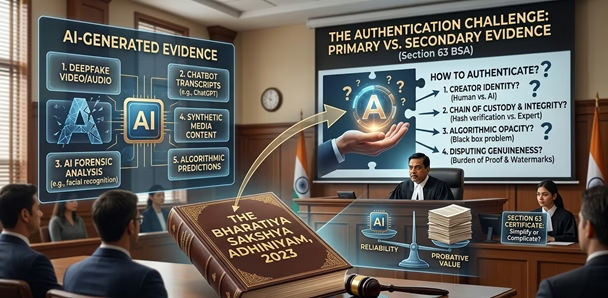
AI-Generated Evidence And The Bharatiya Sakshya Adhiniyam, 2023: Rethinking Authentication Standards
Abstract AI has transformed the nature of evidence, allowing the production of extremely convincing synthetic media such as fake videos, voice clones and AI-generated documents. The Bharatiya Sakshya Adhiniyam, 2023 (‘BSA’) acknowledges electronic and digital records and lays down guidelines for the admissibility of such records, but does not explicitly mention evidence created with the…
-
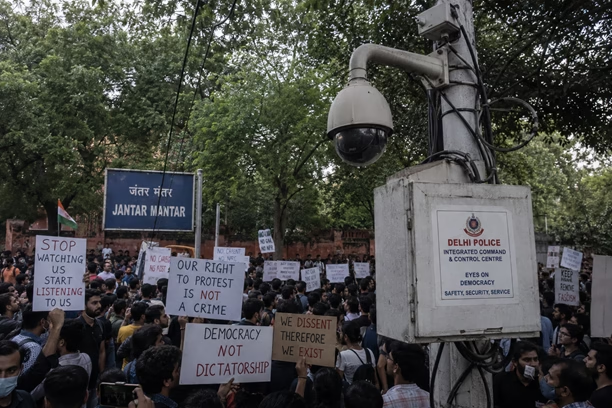
The Right To Protest In The Age Of Artificial Intelligence: Predictive Policing, Facial Recognition, And Democratic Freedoms
Abstract This article critically examines the constitutional implications of the growing deployment of Artificial Intelligence-driven surveillance technologies, particularly facial recognition technology and predictive policing, during public protests in India. Taking the 2026 Jantar Mantar student protests and the ensuing constitutional litigation as its point of departure, the article analyses the intersection of the right to…
-
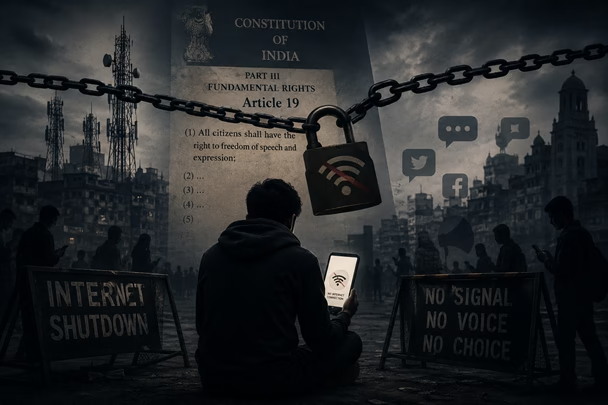
The Invisible Protest: Can Internet Shutdowns Extinguish Article 19 Without Touching The Streets?
Abstract In the summer of 2026, the Internet generation, raised[1] [2] at digital cafes, transformed [3] [4] Jantar Mantar into one of the main spots for the greatest and most impactful mobilizing of the students in India’s recent history. First, it was an expression of disgust toward the supposed exposure of the NEET-UG question paper, followed by other…
-
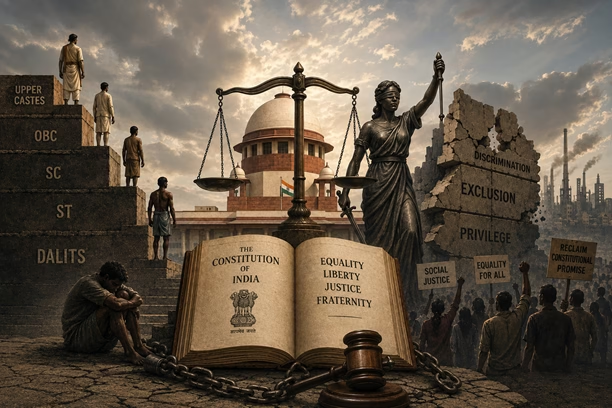
Caste, Courts and Structural Inequality: Reimagining Indian Constitutionalism Through Critical Legal Studies
Abstract This article critically interrogates the structural relationship between caste hierarchy and Indian constitutionalism through the analytical lens of Critical Legal Studies (CLS). While the Constitution of India, forged in the transformative imagination of B.R. Ambedkar, promised a thoroughgoing rupture with hereditary social subordination, the institutional practice of Indian law has frequently reproduced the very…
-
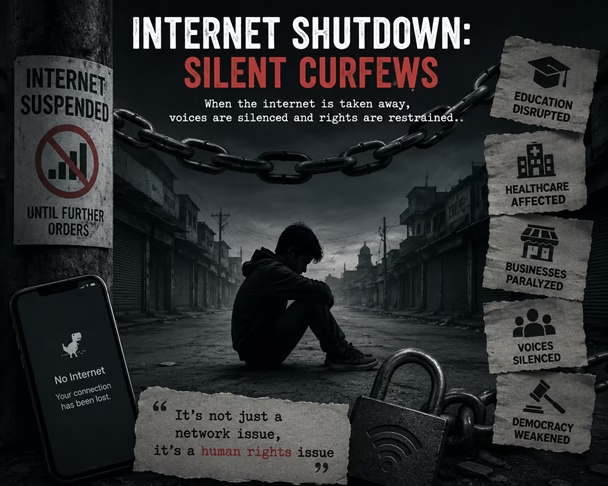
Internet Shutdowns As Silent Curfews: Reimagining Constitutional Limits On Digital Blackouts During Public Protests
Abstract The internet has become an essential part of everyday life and plays an important role in the exercise of constitutional rights. During public protests, however, governments sometimes suspend internet services to maintain public order and national security. This article examines whether such shutdowns are consistent with the constitutional principles of legality, necessity, proportionality and…
-

Regulating Digital Gaming In India: Skill Vs. Chance, Federalism, And The Constitutional Limits Of PROGA 2025
The ancient Indian epic Mahabharata tells the story of a great war between rival factions that was set in motion by a game of dice. The episode serves as a cautionary tale about the attraction and dangers of gambling. Inspired by such teachings, Indian law has long sought to act as a guardian of fair…
-

From Crime To Process: India’s Journey Toward De Facto Death Penalty Abolition
Abstract This article examines the Indian Supreme Court’s shift from focusing on the crime in death penalty cases to focusing on the fairness of the sentencing process. It argues that recent cases have made procedural safeguards central to capital punishment, creating a de facto move toward abolition without formal repeal. Using cases such as Bachan Singh, Shatrughan…
-

Right to Menstrual Hygiene – Proclamation is Easier Than Implementation
Abstract From time immemorial, menstruation was a taboo. It was only in the late 1800s that the scientific awareness of women bleeding into their clothes and then using the same clothes for four to eight days came to the minds of people. The beings got ignited with the idea of “hygiene”, “cleanliness”, and “comfort”. The…