
Law and Tech
-

Face Recognition and Biometric Surveillance: Revisiting Puttaswamy Through Semantic-Originalist Lens
A Live Controversy, Not a Recap: Why Puttaswamy Is Being Tested Again Recently, India witnessed a strong student-led protest against the paper leaks in the prestigious National Eligibility-cum-Entrance Test (NEET), which is a national level entrance test for admission into medical colleges. The protest spanned across many cities and police personnels were deployed for maintenance…
-
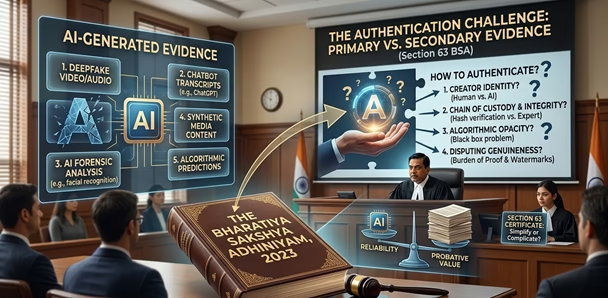
AI-Generated Evidence And The Bharatiya Sakshya Adhiniyam, 2023: Rethinking Authentication Standards
Abstract AI has transformed the nature of evidence, allowing the production of extremely convincing synthetic media such as fake videos, voice clones and AI-generated documents. The Bharatiya Sakshya Adhiniyam, 2023 (‘BSA’) acknowledges electronic and digital records and lays down guidelines for the admissibility of such records, but does not explicitly mention evidence created with the…
-
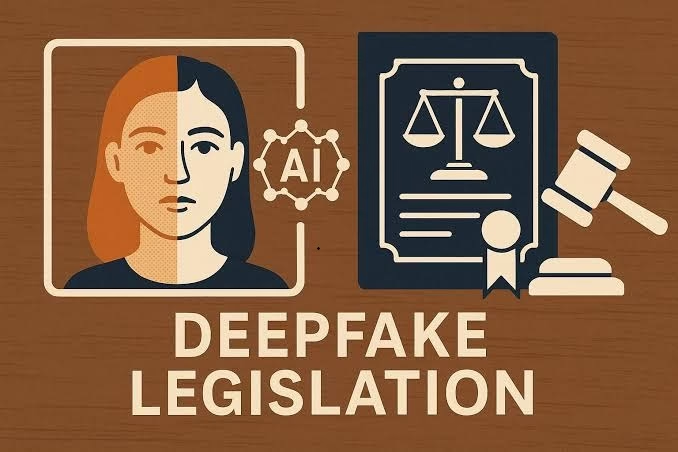
Deepfakes as Weapons of Gendered Disinformation and the Failure of Existing Legal Remedies to Protect Victims
Introduction of Artificial Intelligence (AI) and its development into a deeply refined system which results in realistic outcomes has brought forth an epidemic of misinformation, privacy concerns and defamation issues. The Deepfakes are essentially either cured content or content entirely created from scratch in the form of image, audio or video. As the name in…
-
AI in the Courtroom: Analyzing India’s Draft Judicial AI Regulations in a Global Context
Abstract Artificial Intelligence (AI) is rapidly moving from closed testing environments into real-world execution across several sectors. The incorporation of AI into judicial frameworks is now a reality. Unlike other sectors, judicial decision-making is bound to human reasoning, and unchecked AI deployment raises serious concerns about due process and the protection of fundamental rights. This…
-

Coding Sustainability: Is The ‘Right To Repair’ India’s Key To Sustainable AI Development?
ABSTRACT As the Indian government continues to invest heavily in artificial intelligence (AI) to advance economic growth, innovation, and technological self-reliance, the environmental consequences of AI development and deployment demand greater attention from policymakers and the public alike. AI systems rely on resource-intensive hardware, substantial energy consumption, and frequent device replacement cycles, often exacerbated by…
-
Algorithmic Justice or Psychological Bias 2.0? Rethinking AI Risk Assessment in Criminal Sentencing
This shift toward algorithmic sentencing represents a new frontier for Critical Legal Studies, where the indeterminacy of human judgment is replaced by an opaque ideology of data-driven objectivity that masks traditional power imbalances. The Facade of Objectivity – Unmasking the Neutrality Myth What if, in criminal sentencing, the most potent bias is no longer visible?…
-
Are We Ready For Neurotechnology?
Abstract The future of human-machine interaction is quickly shifting towards a more intimate and direct relationship between humans and machines, with the aid of technology like Brain-Computer Interfaces (BCIs). Although these advancements in medicine, communication and accessibility may seem like great opportunities, they are also risking mental privacy, cognitive freedom and human autonomy. Existing legal…
-
New Age Discrimination: AI and Social Justice
Abstract The blog critically examines the impact of Artificial Intelligence on social justice by studying hindrance in systematic procedures called as “algorithmic bias.” It critically scrutinizes the current digital law frameworks including the European and Indian Laws and its implementation around the world with the help of real-life examples, advocating a need for adopting an…
-

Authorless Creations: Why India’s Copyright Law Is Not Ready forAI-Generated Works
Abstract With the increasing presence of AI in our lives, and its unavoidable ability to replace human thought, it is of much importance that the capability of Indian Laws in this aspect is assessed. Rooted in the assumption of human authorship, the Indian Laws fail to account for AI as an author of a creation. …
-

The Service That Serves Itself: Unfair Trade Practices And Conflict Of Interest In AI Platforms Under Indian Consumer Protection Law
Imagine asking an AI-powered financial assistant embedded in a popular fintech application whether you should invest in a particular mutual fund. The assistant recommends it confidently, in fluent Hindi or English, with the warmth of a trusted advisor. What the assistant does not tell you is that the mutual fund in question is offered by…