
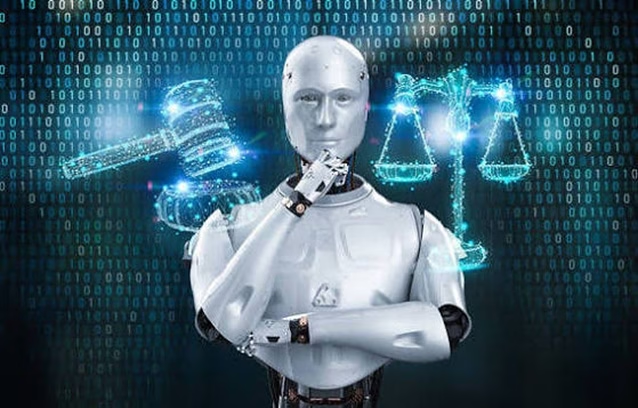
“The delivery of justice must be guided by human conscience and not algorithms.”
This shift toward algorithmic sentencing represents a new frontier for Critical Legal Studies, where the indeterminacy of human judgment is replaced by an opaque ideology of data-driven objectivity that masks traditional power imbalances.
The Facade of Objectivity – Unmasking the Neutrality Myth
What if, in criminal sentencing, the most potent bias is no longer visible? In the current scenario, the rising application of algorithmic assessment tools in the courts, esp. the criminal courts, aims to make justice fairer and backed by data. These systems, by using statistical tools, claim to remove human bias and form an estimate about who might commit a crime again (recidivism). As a result, it has created an overpowering assumption: that AI is neutral and free from any sort of bias, and a better alternative to human judgment, which is prone to committing errors. However, this belief of ‘objectivity’ is worth questioning, because most often the algorithms are a reflection of human ‘opinions embedded in code’ and carry a certain degree of human bias rather than being neutral oracles.The human prejudice is not removed in the sentencing given by AI; it basically converts it into an authority that persuades people psychologically, and is safeguarded by the institutions. Thus, it makes it harder to detect and challenge the presence of bias.
The Algorithmic Anchor: How AI Sets the Judicial Tone
The procedure that is adopted by our judicial system for pronouncing verdicts is often considered rational and free from any undue influence. However, it is not exactly the case as revealed by psychological research. Just like any other decision-maker, the decisions of judges are also affected by cognitive biases and their individual thinking capacity. One form of bias is ‘anchoring’: under this, based on first-hand information received, individuals make their judgments. In cases where AI plays an assisting role in sentencing, a risk score – especially seen as ‘high-risk’ becomes a vital piece of information that is often termed as ‘algorithmic anchor.’ A psychological base point is created, and all ensuing reasoning is shaped by it. Though judges may attempt to be neutral, they are merely modifying themselves from their initial position, rather than making evaluations that are fully independent.
Another pitfall of automation bias is that it hampers the questioning ability of individuals, making them blindly rely on the recommendations given by automated systems. Owing to the time constraints and excessive workload, judges get overly dependent on such tools to comprehend complex cases. Thus, when automation architects judicial logic, independent assessment becomes the first casualty of the system’s design.
The Loop of Prejudice: How Data Sanitizes Systemic Bias
AI systems are often viewed as objective on the presumption that the data on which they are trained and which they use is neutral and free from any bias. However, these algorithmic tools are conditioned on data related to past criminal records, which is already ingrained with systemic biases. For instance, data reflecting social inequality and the over-policing of certain marginalized communities. Consequently, these tools not only train and analyze existing biased patterns, but they also repeat them.
A ‘loop of prejudice’ is formed because of this process. Owing to historical data on which AI gets trained, it is biased – it generates biased predictions – judges rely on these predictions to form an opinion, thus creating a loop of decision-making. As a result, it frames a perception towards a particular group as being ‘inherently risky,’ not because of the act they committed, but because the algorithm keeps repeating that narrative, forming a loop.
What differentiates human bias from algorithmic bias is that, in contrast to algorithmic bias, being shadowed behind stats, data, and complex language (black-box problem), human bias is visible and can be questioned. When the data itself is filled with prejudices, it often appears to be fair and unbiased. This gives rise to what we may refer to as a ‘transparency gap’ – since the algorithm operates in a complex and opaque manner, its biased results are usually not noticed by the courts. Consequently, the system itself seems to be fair and objective, and thus it does not encourage people to challenge it. The algorithm, instead of eradicating inequality, conceals and strengthens it, permitting these biases to become an unspoken component of the judicial system.
The Psychological Shield: AI and the Erosion of Accountability
Beyond the flaws in the data, the real influence of AI is on our minds as it convinces us to believe that the sentencing given by it is fair and neutral, taking away our ability to question if it is right or wrong. It creates a psychological habit called ‘authoritative bias’ – where individuals tend to place a high degree of trust in these systems, often considering them as experts. This trust is further solidified because of technological mystification – a phenomenon where the system is seen as authentic and reliable owing to its technical complexity.
When the repercussions of the decision are shared with or delegated to an external system, the individuals feel less accountable for the decisions made. This phenomenon is called ‘diffusion of responsibility’. Under this framework, AI creates a psychological distancing effect. The opaque functioning of the algorithm and the technical nature of the tool create an emotional and moral disconnect between the judge who pronounced the sentence and the consequences that arise out of that sentence. This reduces sentencing from a moral judicial function to a technical exercise.
Thus, the moral burden of decision-making is shifted from the judge to the algorithm. AI provides a sense of psychological shield to the judges as it reduces doubts and a sense of accountability that arises from the outcome. This raises the level of satisfaction for the judges by relying on the outputs produced by these tools, even though such dependence harms the case-by-case fairness and sabotages individual judgment. Thus, AI shapes both judicial outcomes and their justification.
Due Process in the Black Box: Legal Stakes of Algorithmic Opacity
The usage of AI in sentencing has led to serious legal and ethical issues. Firstly, the ‘opaque’ or black-box functioning of the algorithm. Since the defendants are unaware of the parameters on which the AI gave a verdict, it becomes hard for them to challenge the legitimacy of the award. The Court stressed this aspect in State v. Loomis, 881 N.W.2d 749 (Wis. 2016), where, despite the concern over the transparent functioning of the tool, the Wisconsin Supreme Court gave a nod to the use of COMPAS risk assessment tools, infringing upon the right to due process.
Secondly, the sole reliance on AI predictions can hamper the fair delivery of justice. It also hinders an individual’s decision-making capability and leaves the defendants at the mercy of statistical probabilities. This strikes at the core aspect of criminal law, i.e., deciding a case on its merits. The Supreme Court of India recently reiterated this concern in Gummadi Usha Rani v. Sure Mallikarjuna Rao (2026)(pt.7), wherein the Court cautioned that the uncontrollable use of AI-generated outputs, where the adjudicating process is not performed by a human being but by AI, is a grave danger to the integrity of the adjudicatory process.
Such reliance ultimately jeopardizes the constitutionally guaranteed right to a fair trial. Ultimately, without putting AI systems on the same parameters of scrutiny, accountability, and transparency as is done with human decisions, the legal system confers unbridled or epistemic powers on AI.
Beyond Technical Accuracy: Reclaiming the Human Element
The ongoing debate over the use of AI in the criminal justice system focuses on whether these systems are biased. The actual issue is the transformation of the thought process of judges by AI, and who will be to blame in case of an error. A 100 percent perfect and fair computer program may still be risky, as it will leave judges lax. When judges depend excessively on a screen, they cease to question the facts and lose their thinking capabilities. It is not about creating an ideal machine, but about safeguarding the human touch.
Hence, to curb this issue, certain concrete measures are required. One of the solutions is to make adversarial algorithmic audits mandatory. Under this, a neutral expert can be hired to check if the AI system is affected by bias or any error, before the courts can rely on it. This would ensure that the tool is examined and not trusted with closed eyes. Another way forward is to form a ‘rebuttable presumption’ of human primacy. The judges should be made to give a reasoned decision, that it was the application of the mind and not an algorithm that guided their sentencing.
Toward Technological Humility: Restoring the Heart of Justice
There is a false presumption that the fusion of AI into the criminal justice system for finalizing a sentence eliminates bias; however, it disguises itself in a more subtle and deep-rooted manner. By injecting bias into the technical and complex data systems, it becomes less visible and thus harder to challenge the presence of bias. To ascertain fairness in the judicial decision-making process, the focus should be on making a concerted effort to address the cognitive vulnerabilities of human adjudicators. The real progress lies in re-establishing judicial independence and reforming in the direction of ‘technological humility.’ This is not to be achieved by halting the use of technology, but by ensuring that the ultimate power of decision-making is a reflection of human will and that technology remains an aid, not the arbiter of justice

Leave a Reply