
July 2026 Issue
-

BIRTHRIGHT OR BUREAUCRATIC RIGHT: THE EROSION OF JUS SOLI AND THE MAKING OF STATELESSNESS
Abstract Citizenship represents the most fundamental legal relationship between an individual and the state. It determines who belongs to the political community and who does not. This article examines how the world’s largest democracies have progressively moved away from birthright citizenship based on jus soli toward a model in which birth alone no longer establishes…
-

Judicial Scrutiny of Health and Social Care Responsibilities in the UK: Trends and Lessons from Key Cases
Introduction For a long time, the interface between local authority social care services and the NHS health responsibilities in England and Wales has been fertile ground for litigation. Local authorities are responsible for the provision of social care, which is subject to a means test. This is mainly provided under the National Assistance Act 1948…
-

WHO DECIDES THE RIGHT TO BELONG?
All people are entitled to a nationality. The declaration in Article 15 of the Universal Declaration of Human Rights (UDHR)[i] seems to make nationality a universal human right. However, citizenship is only a right, not a legal fact for millions around the globe. The United Nations High Commissioner for Refugees (UNHCR) estimates that millions remain…
-
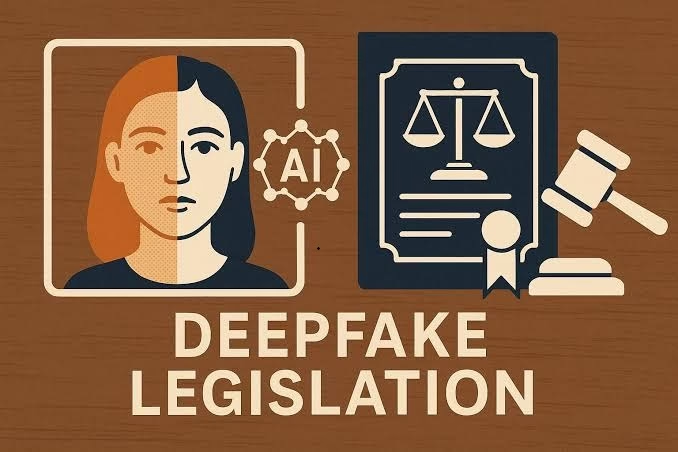
Deepfakes as Weapons of Gendered Disinformation and the Failure of Existing Legal Remedies to Protect Victims
Introduction of Artificial Intelligence (AI) and its development into a deeply refined system which results in realistic outcomes has brought forth an epidemic of misinformation, privacy concerns and defamation issues. The Deepfakes are essentially either cured content or content entirely created from scratch in the form of image, audio or video. As the name in…
-
AI in the Courtroom: Analyzing India’s Draft Judicial AI Regulations in a Global Context
Abstract Artificial Intelligence (AI) is rapidly moving from closed testing environments into real-world execution across several sectors. The incorporation of AI into judicial frameworks is now a reality. Unlike other sectors, judicial decision-making is bound to human reasoning, and unchecked AI deployment raises serious concerns about due process and the protection of fundamental rights. This…
-

The Corporate Algorithm: Evaluating Social Media Censorship of Climate Activism Under Environmental Jurisprudence And Free Speech
Abstract This article explores the alarming intersection of corporate environmental liability and digital constitutionalism. In the modern era, multi-national corporations often wield significant systemic power over social media algorithms, leading to the passive compliance and suppression of grassroots climate activism, a phenomenon termed as ‘Eco-Censorship.’ By analyzing the thin line between private corporate policies and…
-

Coding Sustainability: Is The ‘Right To Repair’ India’s Key To Sustainable AI Development?
ABSTRACT As the Indian government continues to invest heavily in artificial intelligence (AI) to advance economic growth, innovation, and technological self-reliance, the environmental consequences of AI development and deployment demand greater attention from policymakers and the public alike. AI systems rely on resource-intensive hardware, substantial energy consumption, and frequent device replacement cycles, often exacerbated by…
-
Algorithmic Justice or Psychological Bias 2.0? Rethinking AI Risk Assessment in Criminal Sentencing
This shift toward algorithmic sentencing represents a new frontier for Critical Legal Studies, where the indeterminacy of human judgment is replaced by an opaque ideology of data-driven objectivity that masks traditional power imbalances. The Facade of Objectivity – Unmasking the Neutrality Myth What if, in criminal sentencing, the most potent bias is no longer visible?…