
Abstract
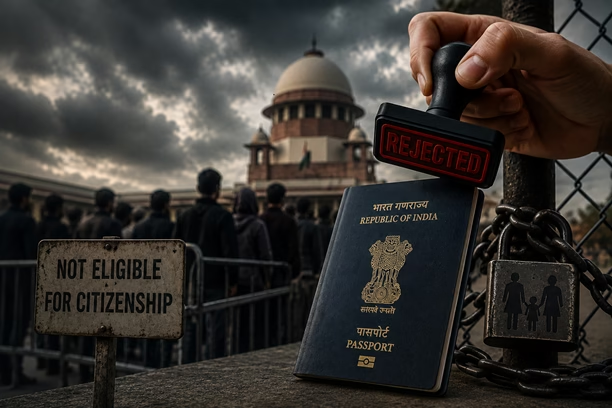
Citizenship has conventionally been seen as a fixed legal status obtained through either birth or parentage. Yet, modern citizenship regimes tend to require continuous proving of one’s belonging by means of identity cards and verification processes. In this article, we explore how the mechanisms of verification, documentary processes, and digital identity infrastructures have changed citizenship from a constitutional right into a conditional legal status subject to verification processes. The article demonstrates that although the above processes can be justified in terms of security concerns, bureaucratic rationalities, and fraud prevention, they usually put vulnerable groups of people, such as women, migrants, informal workers, and economically disadvantaged communities, at risk. The discussion of constitutional issues arising from the above processes is combined with the analysis of the evolution of the problem across different jurisdictions. It is shown how the tension between the power of sovereignty and the right to equal citizenship is being developed in such cases.
From Citizenship Status to Citizenship Scrutiny
Citizenship has historically been viewed as the basic relationship or link between the individual and the state, granting an assured number of rights, protection, and political belonging. Regardless of whether citizenship was based on jus soli or jus sanguinis, it had served as a presumptive status that once obtained upon birth or affiliation and did not need further confirmation. Birthright citizenship, as enshrined in the Fourteenth Amendment to the Constitution of the United States, for example, emerged in the aftermath of the Civil War.
Nevertheless, in today’s governmental systems, this sense of continuity is being replaced by a more qualified process of belonging that is subject to ongoing assessment. States in the modern age are slowly transforming citizenship through processes of verification, documentation, and bureaucracy, usually aided by large-scale identity systems like India’s Aadhaar. In this process, citizenship is not simply asserted or bestowed; rather, it must be constantly proved through compliance with changing demands for evidence and bureaucracy.
This change represents the underlying shift in the interaction between the individual and the state, in which belonging is established through mechanisms of identification and validation, rather than being assumed through status alone.
The following discussion introduces the core idea of this paper, in which citizenship is shifting from its current form, based on status, to something much more contingent, providing the framework for the discussion of the machinery of exclusion.
Conceptual Shift: From Status to Conditional Belonging
Whereas the notion of citizenship has been conventionally viewed as a legal status that persists indefinitely, citizenship has been evolving into a conditional form of belonging to be validated on an ongoing basis. The idea of citizenship as conditional belonging represents a new development that deviates significantly from conventional forms of citizenship such as jus soli and jus sanguinis, which were based largely on birth or lineage criteria for determining political membership. Jus soli, as provided by the U.S. Constitution via the Fourteenth Amendment, provided that citizenship was territorially based.
Rather, in today’s world of governance, there is increasing focus on documentation, administration, and compliance with criteria defined by the state. This can be seen in citizenship laws as well, for example, the Citizenship Act of 1955 (India), in which the criterion of legal membership is defined procedurally.
This is part of a larger realignment of the logic of state sovereignty. Citizenship is no longer seen as just being about one’s legal status but is understood as a regulated situation where one may have to undergo scrutiny and evaluation and even challenge their citizenship in some situations. Identity infrastructure systems like India’s Aadhaar system have only helped solidify this process.
Verification as Governance
Verification has gradually come to assume a critical role as an instrument of governance within modern administrative states. Unlike the traditional conception of verification as merely a procedural tool, verification has become a substantive tool used by the state for inclusion, entitlement, and control over access to welfare and legal recognition. Infrastructure of identity in the form of India’s Aadhaar project is a case in point of this new trend, as it relies on the use of biometric systems and centralised databases. Another example of digitised identity infrastructure is the Estonian e-Identity system.
In essence, verification alters the dynamic between the individual and the state because it shifts the position of trust. In verifying the identity of the individual, the state no longer relies on the citizenship status of the person; rather, it places him or her under an obligation to continually verify his or her own identity.
This rationale goes beyond the provision of welfare services to other areas of governance such as those that govern migration control mechanisms like the U.S. E-Verify system, voter registration policies, and citizenship status determination procedures. This creates an administrative form of rationality where visibility to the state is a prerequisite for the exercise of any rights whatsoever. Individuals who do not satisfy the verification requirements become invisible from the administrative perspective.
In this way, the process of verification does not simply remain an instrumental technology, but a mode of governance through which inclusion and exclusion are actually structured. By producing hierarchies of “legible” and “illegible” populations, it delineates the contours of citizenship. In doing so, it constitutes a central battleground in which state authority is exercised and challenged.
Documentation and Burden of Proof
Documentation has now become the major way through which citizenship is acquired, acknowledged, and maintained in current legal systems. Forms of identification, including birth certificates, residence documents, and national identification systems such as Aadhaar in India, have come to play an important role as the major form of evidence for legal membership. However, this dependence on documentation has created a structural change in the distribution of proof, whereby the burden of proof shifts from the state to the individual.
While in principle citizenship is a legal status, in reality it is increasingly dependent on one’s ability to maintain documentation continuously. Paradoxically, individuals are now expected to provide documentary evidence for the facts of their identity and existence at times when these facts had not been documented officially.
The distribution of the burden of documentation is unequal. Marginalised groups, such as rural communities, migrants, and married women who change their names or statuses through social custom, often find themselves at a disadvantage in terms of documentation continuity. In comparative terms, one example would be the UK system of National Identity documentation (traditionally done through passports and civil registry systems) Consequently, documentation takes on the role of not only being evidence of citizenship but also as being a tool that dictates access to citizenship. Lack or absence of documentation often means deprivation of rights that are constitutionally available.
Therefore, documentation functions not only as proof of belonging but also as a tool of exclusion in citizenship regimes.
The rise of digital identification systems has had a tremendous impact on the structure of citizen verification. The state uses biometric and digitally verified systems to improve its governance functions and service delivery. In India, for instance, massive digitisation is associated with government programs including the DigiLocker system that allows the storage and authentication of official documents without using paper. This trend is reflected in initiatives like the ID4D of the World Bank.
Whereas digital identification systems are defended on the basis of their efficiency, transparency, and inclusiveness, they also produce new types of exclusions. The very existence of a digital identity implies having stable Internet connections, being able to use technology, and proper functioning of biometrics. Technical glitches such as failure to authenticate, service downtime, and data inconsistencies may lead to the denial of important social services. This represents the transition from document-related exclusions to technology-mediated ones. Citizenship is determined not just by having official documents that provide one with certain citizenship but also through one’s ability to interact with technology. Those who cannot access those systems are going to be considered “digitally invisible” and thus become deprived of welfare and administration despite having rights. This way, digital identity systems turn citizenship into a technologically mediated condition of access.
Differentiated Impacts of Exclusion (Gender, Class, Informality)
The mechanism of exclusion works differentially, resulting in varied impacts depending on gender, class, and economic informality. Citizenship verification procedures are based on stable identities and continuous documentation, which is not always possible for everyone. Women are especially affected by the structural constraints of documentary systems. Surname change at marriage, lack of individual property documentation, and family-based documentation practices hinder identity consistency and thus the process of verification. Similarly, people involved in the informal economy or periodic migration face the problem of fragmented administrative presence. Absence of stable work and residence makes it difficult for them to obtain continuous documentation.
Class differences also accentuate the above issues, since legal, bureaucratic, and digital support mechanisms are unevenly accessible. Research into identity exclusion and welfare delivery, such as studies on inclusive identity systems by the United Nations Development Programme, demonstrates the impact of structural inequalities on access to legal status. Documentation procedures do not eliminate, but reproduce social inequalities in the process of citizenship verification and recognition.
Impacts: Detention, Exclusion, Legal Fragility
The growing relationship between documentation and citizenship validation brings legal and humanitarian impacts. As the connection between citizenship and documentation validation grows stronger, any failure to provide sufficient proof or for the systems to recognise documentation will result in the denial of rights, legal insecurity, and, in some cases, detention.
There have been cases wherein citizenship processes and procedures have demonstrated how administrative categorisation can impact freedom and the enjoyment of rights. Statelessness and legal exclusion reports under the framework of the UNHCR Statelessness Convention have illustrated how lack of proper documentation has made individuals vulnerable to being stateless.
Structural Logic of Exclusion
Verification, documentation, and digital authentication processes do not stand alone; rather, they are part of a complex networked architecture of governance that collectively leads to exclusion. While each system from administrative databases, identity registers, and welfare authentication platforms is claimed to be necessary for efficiency, transparency, or fraud protection, their collective effect is the creation of a system where inclusion remains contingent.
This structural logic turns the concept of citizenship from an established status right into a conditional process of citizenship management. The state, through the verification regime, not only establishes eligibility criteria but also maintains the ability of citizens to become recognisable in administrative systems. Citizenship is turned into a process, not a presumption anymore. Critical studies of “administrative burden” and governance design, such as those discussed by the OECD, with regard to digital transformation in the public sector, must explain how the very design of a system can generate exclusion without any intention of exclusion.
The sequential process inherent in the design has made its discriminatory effect seem far from unintentional. Citizenship is not something that is established through the proclamation in the constitution but is achieved through the process of recognition within a verification process. This demonstrates how documentation has changed from being something used for proof into an enforcement instrument. The legal identity is susceptible to danger since it depends on verification and not presumption.
In such circumstances, what is created is a form of “legal liminality,” whereby individuals may be physically located within the territory of the state, yet doubtful about their legal inclusion. The status of citizenship becomes weak and subject to procedural failures that may undermine an individual’s liberty, dignity, and constitutional rights. It means that the citizenship status becomes conditional and administrative, whereby ongoing recognition is more and more dependent on the documentation process rather than certainty of legal inclusion
Normative & Constitutional Questions
Verification-based systems of citizenship pose important normative and constitutional questions about issues related to equality, dignity and due process. While the use of documentation and procedures to verify citizenship may increase risks of arbitrary decision-making and disproportionate discrimination against vulnerable groups. From a constitutional perspective, there is a conflict between the sovereign power of the state to decide who is to be a member of its citizenry and the individual right to legal existence and equality before the law. Given that citizenship depends on processes rather than an established status, the risk of constitutional guarantees being weakened by administrative discretion increases significantly.
It is important to note judicial interventions into the question of identity and citizenship, as discussed, for example, in cases analysed by the Supreme Court of India concerning due process and equality considerations. Therefore, the issue from a normative perspective is to make sure that the use of verification procedures does not result in the erosion of constitutional protections. It is important for the system of law, which embraces the notions of dignity and equality, to prevent the use of processes from becoming a bar to citizenship itself.
Conclusion: Thinking Again About Belonging
The machine of exclusion shows that there is an important change taking place in relation to what citizenship means within modern governance systems. Instead of citizenship being a stable legal relationship based on birth, recognition, or constitution, citizenship is becoming more and more of something that needs to be shown continually through documentation and other mechanisms. Where citizenship is not something that can be taken for granted but something that needs to be continually proven, the problem arises of exclusion becoming part of normal governmental operations rather than exceptional legal practice.
In this respect, international norms on legal identity emphasise the need for inclusive and rights-based systems for identity. UN Sustainable Development Goal Target 16.9, for instance, states that it is necessary to provide legal identity for everyone, including birth registration, by 2030. The World Bank ID4D initiative, in its turn, emphasises the need to develop trustworthy, inclusive, and secure digital identity systems that will allow access to public services and entitlements and that, at the same time, will try to reduce exclusion and guarantee human rights.

Leave a Reply