
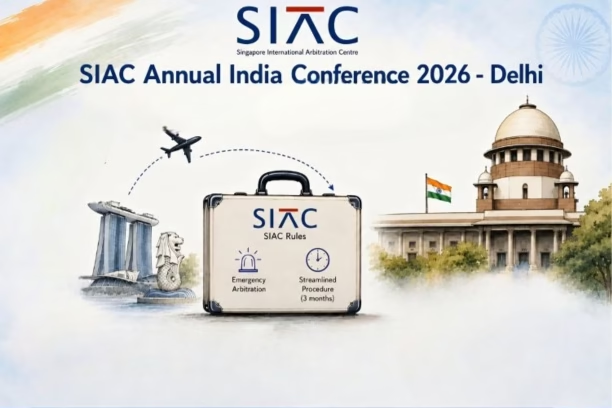
The Singapore International Arbitration Centre’s opening of a liaison office in New Delhi is unquestionably good news for India’s arbitration community. It brings a leading global institution closer to Indian businesses, counsel, arbitrators and students; expands access to training and institutional expertise; and confirms India’s commercial importance in the Asian dispute-resolution market. Yet the development should not be celebrated without reflection. SIAC’s third office in India is also a reminder that Indian parties have helped build Singapore’s arbitration success while India continues to struggle to convert its enormous disputes market into a globally preferred arbitral seat and institutional base.[i]
That tension is captured by the numbers. Between 2011 and 2025, SIAC administered more than 1,600 arbitrations involving over 2,600 Indian parties, representing approximately 24 per cent of the cases handled by SIAC during that period. Indian users also accounted for around 30 per cent of SIAC’s emergency-arbitrator applications. These figures demonstrate both sophistication and sustained confidence in institutional arbitration. But they also reveal an uncomfortable reality: a substantial proportion of disputes generated by Indian commerce continues to be administered by an institution headquartered outside India, frequently with Singapore selected as the seat.[ii]
Crucially, a liaison office is not itself an arbitral seat. The legal seat remains the jurisdiction selected in the arbitration agreement or otherwise determined under the applicable legal framework. It is the courts of that seat that ordinarily exercise supervisory jurisdiction over the arbitration. SIAC’s office may bring its outreach and services closer to Delhi, but unless parties begin choosing India as the seat, much of the valuable legal work connected with court supervision, challenges to awards and specialised arbitration jurisprudence may continue to accrue elsewhere.
The Delhi office is therefore both a vote of confidence and a competitive signal. It is a vote of confidence because SIAC would not deepen its presence in India without sustained demand, strong practitioners, and a commercially significant user base. It is a competitive signal because international arbitral institutions do not merely serve existing markets; they actively cultivate them. Through conferences, training programmes, model clauses, professional networks and direct engagement with in-house counsel, institutions influence future contractual choices. SIAC’s proximity may still make it easier for Indian parties to select the SIAC Rules and Singapore as the seat.
India should welcome this competition rather than respond defensively. Arbitration is founded on party autonomy, and Indian parties must remain free to select the institution and seat they consider most reliable. Any protectionist preference for domestic institutions would damage, rather than advance, India’s global ambitions. The appropriate response is not to restrict SIAC’s presence, but to ask why Indian institutions are not yet attracting comparable numbers of foreign users and India-seated international cases.
The distinction between an arbitration market and an arbitration hub is critical. India is already a vast arbitration market because its infrastructure, construction, energy, technology and financial sectors generate complex commercial disputes. A genuine hub, however, is a jurisdiction voluntarily selected by parties who may have no connection with it. It exports dispute-resolution services rather than merely exporting disputes.
The 2025 Queen Mary University of London and White & Case International Arbitration Survey ranked Singapore among the world’s most preferred arbitral seats and SIAC Rules among the five most preferred sets of arbitration rules. India did not appear among the leading global seats. The relevant benchmark is therefore not simply how many Indian parties participate in arbitration, but how many foreign parties are prepared to choose an Indian city, Indian procedural law and an Indian arbitral institution for a dispute otherwise unconnected with India.[iii]
India has not lacked legislative ambition. Parliament established the India International Arbitration Centre as an institution of national importance, expressly intending to create an independent and autonomous regime for institutional arbitration and to develop India as an arbitration hub. The IIAC’s 2023 Conduct of Arbitration Regulations, including their provision for emergency arbitration, represent a meaningful attempt to align its procedural architecture with international practice.[iv]
India also possesses a deep pool of experienced counsel, arbitrators, former judges, academics and tribunal secretaries. The missing ingredient is not legal talent. It is the accumulation of institutional trust.
Trust cannot be produced merely by legislation, government funding or ceremonial declarations. Leading arbitral institutions earn legitimacy through transparent appointment practices, professional case management, rigorous conflict-management systems, predictable timelines, scrutiny of awards and publication of meaningful caseload data. Indian institutions must demonstrate that their governance is operationally independent, professionally administered and responsive to users. They must compete not only on cost, but also on procedural certainty, administrative quality and international credibility.
The courts are equally important. The Supreme Court’s decision in Central Organisation for Railway Electrification v ECI-SPIC-SMO-MCML (JV) strengthened equality and impartiality in tribunal constitution by rejecting appointment mechanisms that allow one party to dominate the selection process.[v] Such decisions improve India’s arbitration credentials. Nevertheless, international users assess a seat through the overall consistency of its supervisory judiciary: the speed of interim relief, restraint at the setting-aside stage, enforcement of awards and avoidance of frequent doctrinal reversals.
A global seat is built when commercial parties can predict not merely what the legislation says, but how courts will apply it.
Government conduct must also match government rhetoric. The Ministry of Finance’s 2024 public-procurement guidelines advised that arbitration should not be routinely included in government contracts and, as a norm, restricted arbitration to disputes below ₹10 crore unless higher-level approval was obtained. Whatever the concerns regarding cost, delay or defective awards, this policy signal is difficult to reconcile with the declared objective of promoting institutional arbitration.[vi]
The State and its entities are among India’s largest commercial disputants. If the Government responds to defective arbitration by returning high-value disputes to already burdened courts, it weakens demand for the institutions it simultaneously seeks to develop. The more constructive solution is better drafting of arbitration clauses, professional institutional administration, appointment of specialist neutrals, disciplined case management and meaningful consequences for inflated claims and frivolous challenges.
The SIAC office may nevertheless generate valuable positive spillovers. It can expose younger Indian practitioners to international case-management standards, create further opportunities for Indian arbitrators and strengthen cooperation between Singaporean and Indian institutions. Singapore’s Minister for Law expressly described SIAC’s presence as complementary rather than competitive and invited Indian arbitral institutions to establish a corresponding presence in Singapore.[vii]
India should accept that invitation in substance, not merely symbolically. IIAC and other credible Indian institutions should build overseas partnerships, publish sophisticated model clauses, engage directly with international in-house counsel and actively seek disputes that have no territorial connection with India.
Ultimately, New Delhi does not become an arbitration hub merely because an international institution opens an office there. Nor does India lose its arbitration dream because Indian parties continue to choose SIAC. The decisive question is whether India can convert proximity to international institutions into domestic institutional credibility.
The correct verdict is therefore both. SIAC’s expansion is good for Indian arbitration because competition, professional exchange and greater access to institutional services benefit users. But it is also a wake-up call. India’s global-hub ambition will remain aspirational until Indian institutions are selected for their independence and performance, Indian seats are chosen by neutral foreign parties, courts provide consistent supervisory support, and the Government itself becomes a model user of arbitration.
A global arbitration hub is not declared. It is repeatedly chosen.
[i] Ministry of Law Singapore, ‘Minister Edwin Tong to Launch SIAC Delhi Liaison Office’ (Press Release, 25 July 2026); ‘SIAC Opens Delhi Liaison Office, Strengthening Engagement with India’s Arbitration Ecosystem’ SCC Times (25 July 2026).
[ii] Edwin Tong SC, ‘Keynote Speech at the SIAC Delhi Conference’ (New Delhi, 25 July 2026) paras 36–44.
[iii] White & Case and Queen Mary University of London, 2025 International Arbitration Survey: The Path Forward—Realities and Opportunities in Arbitration (2025) 8–10.
[iv] India International Arbitration Centre Act 2019, preamble and ss 3–4, 14–15; India International Arbitration Centre (Conduct of Arbitration) Regulations 2023, reg 18.
[v] Central Organisation for Railway Electrification v ECI-SPIC-SMO-MCML (JV) 2024 INSC 857.
[vi] Department of Expenditure, Ministry of Finance, ‘Guidelines for Arbitration and Mediation in Contracts of Domestic Public Procurement’ Office Memorandum No F 1/2/2024-PPD (3 June 2024) paras 4–5.
[vii] Edwin Tong SC (n 2) paras 45–48.

Leave a Reply