
Citizenship
-
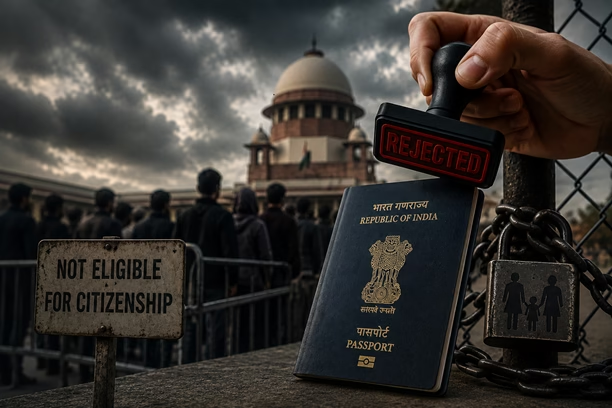
The Machinery of Exclusion: Verification, Documentation, and Proof of Membership
Abstract Citizenship has conventionally been seen as a fixed legal status obtained through either birth or parentage. Yet, modern citizenship regimes tend to require continuous proving of one’s belonging by means of identity cards and verification processes. In this article, we explore how the mechanisms of verification, documentary processes, and digital identity infrastructures have changed…
-

BIRTHRIGHT OR BUREAUCRATIC RIGHT: THE EROSION OF JUS SOLI AND THE MAKING OF STATELESSNESS
Abstract Citizenship represents the most fundamental legal relationship between an individual and the state. It determines who belongs to the political community and who does not. This article examines how the world’s largest democracies have progressively moved away from birthright citizenship based on jus soli toward a model in which birth alone no longer establishes…
-

WHO DECIDES THE RIGHT TO BELONG?
All people are entitled to a nationality. The declaration in Article 15 of the Universal Declaration of Human Rights (UDHR)[i] seems to make nationality a universal human right. However, citizenship is only a right, not a legal fact for millions around the globe. The United Nations High Commissioner for Refugees (UNHCR) estimates that millions remain…