
Constitution
-

Industrial Relations Code, 2020: Collective Bargaining Without Strong Rights?
New labour codes namely Code of Social Security, 2020; The OSH Code, 2020; Code of Wages, 2019; and IR Code, 2020, are enacted and consolidated 29 central laws, with the aim of unification, simplification and to promote ease of doing business, which was also the recommendation of 2nd labour commission in 2002. Pre-labour law such…
-
Case 7 & 8: Vertical Limit | Dr. Alexander Espinoza Rausseo, Dr. Jhenny de Fátima Rivas Alberti write for Virtuosity Legal
Boyce Garrett has decided to take a trip to Utah, where he will enjoy rock climbing with his two sons, Peter and Annie. Due to the negligence of two other climbers, they are hanging from a single anchor point. Boyce recognizes that the anchor in the rock will not be sufficient to hold the weight…
-
Case 6: The Use Of Motorcycle Helmets (Indirect Effect) | Dr. Alexander Espinoza Rausseo, Dr. Jhenny de Fátima Rivas Alberti write for Virtuosity Legal
Alvin has chosen to live a carefree life full of risks and thrills. He declines to assume the duty of safeguarding himself and to wear a protective helmet during his motorcycle expeditions. All participants are competent adults, fully informed, capable of acting rationally, and free from undue pressure. The discussion of whether an individual should…
-
Case 3, 4 & 5: Conflictual Jural Relationships | Dr. Alexander Espinoza Rausseo, Dr. Jhenny de Fátima Rivas Alberti write for Virtuosity Legal
Case 3: Dinner with Friends Alvin has organized a dinner party for friends. However, he has decided to exclude Beto based on discriminatory grounds. Beto insists on his right to be invited. Case 4: Private School Alvin is the proprietor of a private school that has decided to exclude Beto on discriminatory grounds. Beto insists…
-
Case 2: Voluntary Intoxication (Self Regarding Acts) | Dr. Alexander Espinoza Rausseo, Dr. Jhenny de Fátima Rivas Alberti write for Virtuosity Legal
In his personal life, Alvin engages in alcohol consumption, which temporarily hinders his ability to perform tasks requiring rapid decision-making and physical agility. We will assume that his actions do not harm other individuals. Beto is worried about Alvin. He wonders if he can legally intervene and force him to change his habits. All participants…
-
Case 1: Right to Exclude | Dr. Alexander Espinoza Rausseo, Dr. Jhenny de Fátima Rivas Alberti write for Virtuosity Legal
Alvin is the owner of the land upon which his home is situated. He has demarcated the boundaries of his property with a fence and visible signs indicating that he does not wish to allow trespassers to enter. Alvin’s property is located at the midpoint between Beto’s residence and the city. Beto exercises caution and…
-
The Absence Of A Factual Conflict Of Rights | Dr. Alexander Espinoza Rausseo, Dr. Jhenny de Fátima Rivas Alberti write for Virtuosity Legal
We will distinguish between non-conflictual jural relationships, which contain elements that do not admit or require external legislation, but rather internal legislation, and conflictual jural relationships, which must be resolved in order to reestablish a peaceful state of no-right. We inquire into the role of the principle of individual autonomy in the context of non-conflictual…
-
The System Of Reciprocal Duties | Dr. Alexander Espinoza Rausseo, Dr. Jhenny de Fátima Rivas Alberti write for Virtuosity Legal
We will argue that the sphere of duties towards oneself serves as the basis for the entire system of reciprocal duties. The prima facie duties towards oneself are the reasons that allow the conscience to act as an internal judge in order to comply with the duty. This process constitutes the initial step of a…
-
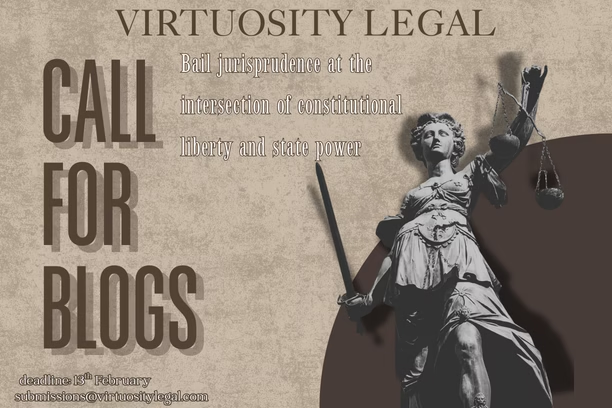
Bail as Exception: The Parallel Legal Order Created by Special Criminal Law
The bail jurisprudence in India is based on the premise that bail is the rule, jail is the exception as observed in the case of Gudikanti Narasimhulu v. Public Prosecutor[i]. This principle originates from Article 21 which stipulates that any restraint on liberty of the individual must be balanced on just, fair and reasonable procedure…