
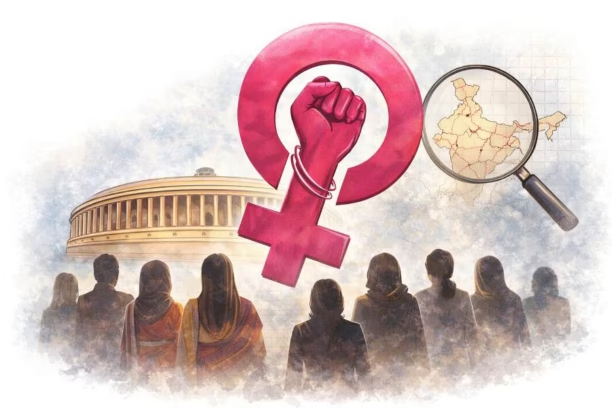
India Promised Women A Seat At The Table, Then Moved the Table
In September 2023, the Indian parliament passed the Nari Shakti Vandan Adhiniyam- the 106th Constitutional Amendment Act welcomed and praised by almost everyone. It was the first time in independent India’s history that 33 percent of seats in the Lok Sabha and State Legislative Assemblies would be reserved for women. The moment was framed as historic, transformative, and long overdue.
Three years later, in 2026, the government made its first move to operationalize the promise that was made three years ago, but the legislative attempt revealed the structural contradiction embedded in its design. The legislation was designed to increase women’s voice in the parliament, but it may simultaneously silence the voices of millions of women in South India. The bill claiming to fulfil the women’s reservation promise is structured in such a way that could substantially diminish the political representation of the states where women are most educated, most empowered, and politically active.
This is not political rhetoric, but constitutional arithmetic, where the numbers demand very careful scrutiny.
The Three-Bill Package And The 2011 Census Problem
The 131st Amendment Bill was subsequently defeated in the Lok Sabha on April 17, 2026, falling short of the required two-thirds special majority needed, so the allied bills were withdrawn. Yet the structural logic embedded in this legislative package and what it reveals about how women’s reservation is being operationalized demands scrutiny regardless of the bills’ immediate fate. The Constitutional (131st Amendment) Bill,2026; the Delimitation Bill,2026; and the Territorial Laws (Amendment) Bill,2026. In that parliamentary session, it was proposed to expand the Lok Sabha seats from 543 to approximately 850, restructure constituency boundaries through a fresh delimitation exercise, and use this delimitation as the basis for implementing women’s reservation.
The government’s stated rationale is defensible in principle. India’s constituencies have not been redrawn since 1971. In Uttar Pradesh, a single MP represents approximately 25 to 30 lakhs of people. It shows a democratic distortion that is mandated to be corrected by Article 82 of the Indian Constitution.
The controversy does not lie in delimitation, but in the specific census data that is driving it. The bills are structured to use 2011 census data (data that is already 15 years old). A new census commenced on 1 April 2026. Article 82 of the Indian Constitution mandates readjustment of constituencies after each census. Using the 15-year-old data, while the fresh count is underway, raises serious questions about the integrity of the exercise and, as the seat projection reveals, its political intent.
Punished for Progress: The Seat Projection No One Wants to Discuss
Since the early 1970s, the demographic trajectories of the states in India have taken dramatically different directions. The Hindi-belt states like Uttar Pradesh, Bihar, Madhya Pradesh, Rajasthan, Haryana, and Chhattisgarh experienced rapid population growth; in contrast, southern states like Tamil Nadu, Kerala, Karnataka, Andhra Pradesh, and Telangana made strong efforts to stabilize their populations by widely adopting family planning.
This was not an accidental divergence. It was the result of conscious state investment in education, health, and women’s empowerment. The 42nd constitutional amendments (1976) and the 84th Amendments (2001) froze the number of seats as the policy makers recognized the perversity that the states are being penalized for their successful demographic governance. The freeze seems to have expired now in 2026, and the consequences are stark.
The developmental contrast makes this even more troubling. Kerala has achieved the highest female literacy rate in the whole country at 92.2 percent. By contrast, Bihar stands at 51.50 percent. Under the delimitation formula of 2026, Bihar gains substantially high seats in the parliament, but at the same time Kerala stagnates- the state that has done much to close the gender gap gains the fewest seats, whereas the state that has done least gains seats. This is not a coincidence, but it is the structural consequence of considering population as the sole measure of democratic representation in a federation with deeply unequal developmental outcomes.
33 Percent of Less Is Still Less
The women’s reservation bill for women in Tamil Nadu, Kerala, Karnataka, Andhra Pradesh, and Telangana presents a cruel dilemma.
The 33 percent reservation is a meaningful guarantee of legislative presence. A woman elected from a reserved constituency of Kerala or Tamil Nadu will hold a constitutional mandate to serve, which is the real, hard-won progress. But also consider what this delimitation does to the broader political architecture within those reserved seats that must function.
If southern states see their combined seats rise only by 39 (129 to 168) while the seats of the Hindi-belt gain 133 seats (195 to 328, the proportion of parliament controlled by Southern states will collapse. Even with a 33 percent reservation for women in those 168 seats, it will reduce the share of southern women MPs’ representation in the national legislature. Their reserved seats would exist within a structural context of marginalization.
Meanwhile, 33 percent of reserved seats in the northern bloc will lead to a far greater absolute number of women MPs from the Hindi belt. In effect, the Women’s Reservation Bill, applied through population-proportional delimitation, will disproportionately benefit women from high-fertility northern states and structurally dilute the total voice of women from the south, precisely those states where women’s education, health, and women’s empowerment are highest.
The promise of more women’s representation in parliament will be kept. But the promise will systematically favor those states that have historically lagged on every woman’s development indicator.
Why Were Women’s Rights Chained To Delimitation?
The leaders from the south have consistently framed this debate not as regionalism but as a question of federal fairness. M.K. Stalin, the chief minister of Tamil Nadu, has called for black-flag protests and warned that the bill threatens to make citizens of southern India second-class participants in their own democratic country. Congress leader P. Chidambaram has warned that the five southern states, which currently hold 129 seats, could see that number fall as low as 103 under strict population-proportional allocation.
The opposition has expressed support for women’s reservation while opposing the delimitation framework, and their central procedural argument is difficult to dismiss that the women’s quota does not need to be tied to delimitation at all. The government could have applied the 33 percent reservation to existing constituencies, as the SC/ST reservation has operated for decades and delivered women’s representation immediately, without any waiting for a contentious and politically fraught redrawing of the map.
That path was available in 2023 itself, and even today, it remains available. The persistent choice to link women’s reservation to delimitation raises a legitimate question: Is women’s reservation the primary objective here, or is it the most politically palatable cover?
An Available Constitutional Path- And Why It Was Not Taken
A constitutionally robust and federal-sensitive approach to women’s reservation would require, at a minimum, three things.
First, it would disengage the implementation of the 33 percent quota from the delimitation exercise. There is no constitutional reason why women’s reservation cannot be applied to existing constituencies, with a rotation reservation cycle mandated under Article 334A. The operational mechanism is well-understood and has precedent.
Second, any delimitation exercise that does proceed should be on the basis of the most current available census data. Using the 2011 census data, especially when a new census is already underway as of April 2026, shows the failure of the basic test of democratic integrity. If the purpose of delimitation is to ensure equal representation, that equality must be calculated on the most accurate available data.
Third, the seat allocation formula must include some mechanism to protect federal balance, even if that means departing partially from strict population proportionality. The issue is not without a solution. Democracies around the world, from the United States to Germany to the European Union, have designed specific safeguards to ensure that states or regions cannot be simply outvoted into irrelevance just because their neighbor had more children. India lacks such protection in its lower house. India’s existing Rajya Sabha was designed to serve some of these functions, but unlike the United States Senate, which gives every state equal representation regardless of population, the Rajya Sabha allocates seats broadly by population, meaning the same demographic reason that has the same disadvantages for southern states in the Lok Sabha has disadvantages in the upper house as well. The Lok Sabha remains the decisive chamber. Expanding it to 850 seats primarily just on the grounds of population without any federal safeguard is a structural choice that will have long-term consequences for the unity of the union.
Conclusion: Injustice With A 33 Percent Discount Is Still Injustice
The Nari Shakti Adhiniyam of 2023 was a historic step towards increasing women’s representation in the parliament. But the three-bill package proposed in April 2026 is its betrayal dressed as its fulfilment.
The foregoing analysis demonstrates that using 15-year-old 2011 census data to expand the Lok Sabha to 850 seats will push Hindi-belt states from 195 to 328 seats, while the five southern states rise only from 129 to 168. Thirty-three percent of that diminished southern bloc is not justice but is arithmetic window dressing.
The cruelty is sharpest in the development contrast; literacy rate of women is 92.2 percent in Kerala, whereas it is 51.50 percent in Bihar. Under the proposed bill, Bihar will gain a number of seats, and Kerala will stagnate. The states that invested most in women’s empowerment are being rewarded with political irrelevance.
The link between women’s reservation and delimitation was never constitutionally necessary. Article 334A of the Indian Constitution permits the quota to be applied to existing constituencies also without any requirement of delimitation as a precondition, as SC/ST reservation has been functioning for decades. The path remains available for women’s reservation as well.
The democracy that penalizes its states for their development and effective planning success is not delivering justice. It is merely rearranging its injustice.

Leave a Reply