
Abstract
The freedom to protest is a crucial dimension of constitutional democracy whereby individuals can express their disapproval of governmental actions, criticize the same and seek accountability. Even though Article 19(1)(a) and 19(1)(b) of the Constitution of India safeguard the freedom of expression and assembly, the regulation of protests is generally oriented more towards considerations of public order and traffic issues than towards anything else. This paper contends that the governance of protests through the lens of the Constitution needs to go beyond mere regulation and take up a facilitative approach. By relying on several cases of the Supreme Court of India such as Himat Lal K Shah v Commissioner of Police, In Re: Ramlila Maidan Incident, Mazdoor Kisan Shakti Sangathan v Union of India, and Amit Sahni v Commissioner of Police, the paper analyzes the interplay between the right to protest and various other public interests.
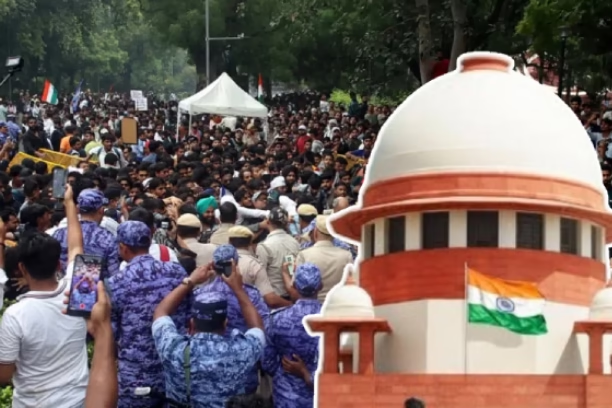
Protest is not an exception to democracy but rather a manifestation of it. For a democracy to function under the constitution, citizens have to be allowed to raise questions about actions of government, disagree with such actions, hold the government accountable, and engage in politics. The Indian Constitution protects freedom of speech and expression under Article 19(1)(a) and the right to assemble peacefully and without arms under Article 19(1)(b).
The constitutional issue arises when regulation of protests goes beyond legitimate public-order concerns and becomes a mechanism for controlling dissent. It is reasonable to consider traffic, safety concerns, conflicts with other rights, and convenience as legitimate issues. Yet, the state which regulates the protests without providing proper conditions of their organization turns a constitutional right into its formality. Thus, the governance of the public protests demands the transition from regulating to facilitating.
The Constitutional Foundation of Protest
Though the constitution does not explicitly talk about “the right to protest”, peaceful protests can be primarily derived from Article 19(1)(a) and Article 19(1)(b). The Supreme Court of India has been consistently affirming that citizens can protest by way of peaceful assemblies in accordance with the restrictions that may be imposed under the constitution.
Himat Lal K Shah v. Commissioner of Police [i]is a landmark case where the Supreme Court of India dealt with the issue of the power of the authorities to regulate public assemblies. Though the Court recognised the State’s power to regulate assemblies, it rejected an unrestricted or arbitrary power to prohibit them.
Another key aspect of the Court’s decision is its recognition of the distinction between regulation and prohibition. While a constitutional right can be reasonably regulated with regard to time, place and manner, this fact alone does not give the State the carte blanche to end the right as such.
Re: Ramlila Maidan Incident [ii]is yet another instance where the constitutional restrictions on police action were highlighted. In this case, the Supreme Court pointed out that while Article 19(1)(a) [iii]and Article 19(1)(b)[iv] guarantee the freedom of speech and the freedom of peaceful assembly, they are nevertheless subject to reasonable restrictions.
From Regulation to Facilitation
The traditional administrative model tends to view protesters as applicants asking for permission from the State. This may give rise to the perception that peaceful protests are a privilege provided by the administration, whereas they are a constitutional right requiring regulation. In the case of a rights-based model, there are different things one needs to understand.
If peaceful assembly is a constitutionally protected activity, the State cannot refrain from unlawfully interfering with it. The State should take reasonable measures to enable its practice. This does not necessarily imply that every protest should be allowed in every place, or that unlimited disruptions are acceptable to the State. On the contrary, a reasonable accommodation should be made by all parties involved.
However, in Mazdoor Kisan Shakti Sangathan v Union of India [v], the Supreme Court weighed the conflicting considerations that arise from protesting in public spaces. The constitutional protection for the protester has to be reconciled with the rights of other individuals who are using the same public space. However, the process of balancing rights need not necessarily entail the removal of protest from public spaces. Instead, one must determine if the restriction serves public order goals without foreclosing dissent.
Thus, a facilitative State would set down clearly defined procedures for arranging protests. Decisions should be made in a timely fashion, and refusals should give reasons in writing. Restrictions must also be made according to objective standards, and alternative arrangements must be found where the site poses any potential problems to safety and traffic.
The Problem of Excessive Regulation
The biggest concern in the management of protests is not regulation but the arbitrary nature of regulation. Discretionary powers are likely to result in uncertainty among the protestors and are likely to foster selective enforcement of rules. The problem becomes even more acute where the protests raise questions about government policy decisions.
In its judgment in Amit Sahni v Commissioner of Police [vi]The Supreme Court of India provides guidance. While recognizing the constitutional right of the people to peacefully protest, the Court ruled that public streets cannot be used in such a way as to cause an unreasonable obstruction to others.
In light of this, there is an indication of moving towards a more balanced approach. On one hand, no government can allow unlimited occupation that is likely to be detrimental to the right to life of others, but on the other hand, mere inconveniences cannot be used as justification to silence peaceful protest and demonstrations.
This is equally applicable to actions by the police force. In the case of Ramlila Maidan Incident v. Home Secretary, Government of National Capital Territory of Delhi [vii], the Supreme Court looked at the actions taken by the police against a gathering and pointed out the importance of life and liberty under the Constitution.
Towards a Facilitative Framework
A rights-based system of administering public demonstrations in India must be more clearly articulated.
First, the process of permission must be clear, predictable, and based on criteria which are published in advance.
Secondly, written reasons for denial of permission or imposition of major restrictions must always be provided by authorities.
Thirdly, restrictions should normally be content-neutral. The State should control the form and effect of an assembly, not discriminate on account of the message expressed therein. The government cannot assume that criticism, simply because it is politically embarrassing, is any less entitled to constitutional protection.
Fourthly, authorities must adopt the least restrictive means approach. Before an assembly is banned, other alternatives such as relocation, re-timing, alteration of route or other conditions can be considered to resolve genuine public order problems.
Lastly, the State has the obligation to ensure the safety of the peaceful protesters themselves. Policing, access and adequate security measures can help to make the exercise of the right possible while at the same time ensuring the safety of other members of the public. Therefore, maintaining public order should also entail reasonable measures to protect peaceful protesters from violence, rather than being understood solely as a mandate to control them.
This approach will limit the discretion of the police in making decisions. Standards in place will help both the protesters and the authority since the protesters will understand the standard that must be met to allow peaceful assembly. In constitutional government, the protection of democracy requires facilitation of the democratic process as a matter of principle.
Conclusion
The right to protest cannot have any significance if the citizen enjoys the right in principle but faces arbitrary obstacles in practice. Where protests endanger public order or seriously impinge on the rights of others, some regulation is clearly necessary. However, such regulation must be proportionate, open and non-discriminatory.
A constitutional democracy must thus shift its approach from that which relies on regulation towards one which focuses more on facilitation. The State needs to regulate in a reasonable way, accommodate dissent wherever it can, ensure peaceful assemblies and act only where constitutional justification exists. “The strength of the democratic process lies not in the absence of protest, but in the capacity of the constitutional framework to accommodate peaceful dissent without jeopardizing public order.”
[i] Himat Lal K Shah v Commissioner of Police (1973) 1 SCC 227.
[ii] Re: Ramlila Maidan Incident (2012) 5 SCC 1.
[iii] Constitution of India 1950, art 19(1)(a)
[iv] Constitution of India 1950, art 19(1)(b)
[v] Mazdoor Kisan Shakti Sangathan v Union of India (2018) 17 SCC 324.
[vi] Amit Sahni v Commissioner of Police (2020) 10 SCC 439.
[vii] Ramlila Maidan Incident v Home Secretary, Union of India & Ors (2012) 5 SCC 1.

Leave a Reply