
Abstract
AI has transformed the nature of evidence, allowing the production of extremely convincing synthetic media such as fake videos, voice clones and AI-generated documents. The Bharatiya Sakshya Adhiniyam, 2023 (‘BSA’) acknowledges electronic and digital records and lays down guidelines for the admissibility of such records, but does not explicitly mention evidence created with the help of artificial intelligence. This article maintains that the assumption by the BSA that digital evidence usually presents reality is still in place. However, generative AI challenges these assumptions, and it generates convincing evidence that can be entirely fake. Therefore, the article argues that Indian evidence law should shift from a certification-based system to a forensic-authentication-based evidence law, to focus more on technical verification, disclosure duties, and expert examination.
The goal of the law of evidence is the discovery of the truth. The rights and liabilities are now judged based on evidence which must be assumed to have a reasonable relation to reality. Traditionally, evidence of transactions would be documented as transactions actually took place, witnesses would tell a story based on what they saw, and electronic evidence would document information created as a result of human actions.
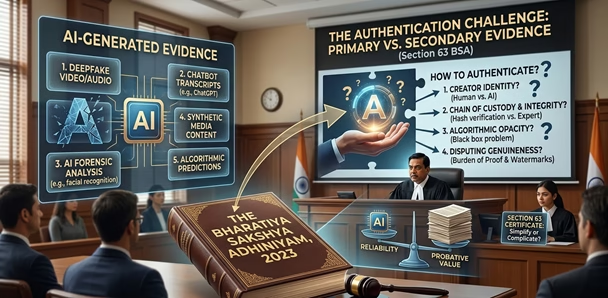
Generative AI has changed all that. Today’s AI systems can generate images of events that never happened, films of people saying things that they didn’t say, and documents that seem entirely real, but are entirely false.[i] These developments are not just about technology; they are also an epistemic challenge to the administration of justice.
The issue is already being detected in India. Deepfakes have been used for misinformation, impersonation and fraud. In 2025, Indian authorities warned about the growing trend of the use of the AI-generated facial replica and synthetic identities to bypass the facial authentication and video verification system.[ii] A similar situation has also raised concerns in impersonation and fabricated media involving public figures and public institutions in connection to AI. As deepfakes become more common, there have been calls for governments to issue warnings and for courts to focus on the implications of deepfakes in society.[iii] In this context, the Bharatiya Sakshya Adhiniyam, 2023 takes on special significance. Section 61, 62 and 63 of the Act provide for the admissibility and proof of electronic records. However, the statutory definition of evidence does not explicitly refer to a type of evidence that can be created without any event.
The problem created by artificial intelligence is not the same kind of problem as electronic evidence has raised in the past, the article states. The question is not just whether digital evidence has been tampered with in transmission or storage, but how. Instead, the main issue is whether the evidence reflects reality in any way.
To Conduct A Literature Review And Existing Scholarship
Historically, legal scholarship has focused on admissibility and certification and the reliability of electronic evidence. It has long been acknowledged that electronic records are unique and susceptible to alteration and duplication compared to face-to-face records.[iv]
But with the advent of generative AI, there has been a focus in academia on authenticity instead of admissibility. The recent literature on deepfakes shows that even ordinary human perception is far from reliable when it comes to detecting fake media. It has also been observed that current detection systems often fail at seeing the through-the-veil aspect of deepfakes in the real world and are still vulnerable to relatively easy manipulation.
A second line of inquiry has been studying the connection between deepfakes and democratic institutions. Research on political deepfakes indicates that synthetic media has a strong potential to influence public opinions and manipulate informational contexts.[v]
The literature so far has thus shown two propositions.
First, there are risks that AI-generated content carries which are distinct from those of traditional electronic records.
Secondly, existing verification systems might fall short of dealing with synthetic media.
In spite of these insights, Indian legal scholarship has started to grapple with the implications of generative AI on the law of evidence. The BSA has updated the rules for electronic evidence but has not dealt directly with the issues that arise from AI evidence. This article aims to fill in this gap.
Why AI-Generated Evidence Is Different
Don’t confuse AI-generated evidence with electronic evidence. A video camera recording, a standard camera recording, normally records an event that actually took place. An email document that documents communication of what actually happened. A photograph normally depicts a situation at a specific moment. Generative AI systems work differently. They can invent realistic representations of events that didn’t happen and communications that did not occur.
The difference is critical from a documentary standpoint. The storage, transmission and alteration of traditional electronic evidence is a concern. The evidence produced by AI brings into doubt the concept of existence. One deepfake of a person taking a bribe could be indistinguishable from the real person’s original voice. A synthetic audio recording can convincingly sound like someone’s voice, and can give the appearance of an admission or confession. AI-generated documents can sometimes sound just like the style and communication of humans.
So, the biggest problem of synthetic media is that it can make believable lies.
The Bharatiya Sakshya Adhiniyam And The Problem Of Authenticity
Part of the BSA governing electronic evidence is established by sections 61, 62 and 63. Section 61 acknowledges that ‘electronic and digital records may not be denied admission on the grounds that they are in an electronic or digital format. Sections 62 and 63 stipulate how the content of electronic records can be established.
The statutory provisions are continuity with the previous electronic evidence jurisprudence, and they are appropriate to the growing importance of digital information.[vi]
The legislation, however, is still mainly medium focused. Its main interest is in the form of information and not the process leading to the production of information. This is problematic, when applied to AI. If you can make a deep fake video, there must be one out there as an electronic record. It might meet formal requirements for storage, transmission and certification. But such evidence may have nothing to do with what it purports to be.
That’s an obvious problem in evidence that the BSA counters with a new one. The law promotes admissibility and gives little advice in terms of authenticity.
By Itself, Certification Is No Longer Enough
Historically, the law on electronic evidence has centred on procedural protections and certification requirements.
This method was suitable where the main type of documents to which courts were exposed were emails, CCTV and computer-generated documents. In these situations, the main concern was the preservation of evidence. The challenge with artificial intelligence is different. Finally, certification can be used to prove that a file came from a specific device or that it was accurately copied and maintained. It may not be able to prove the underlying events actually took place.[vii]
This is an important distinction. A certificate is not sufficient to declare whether a confession was created using voice-cloning technology or a video was produced using machine learning techniques. In the age of generative AI, it is imperative to change the way we think about it. The legal investigation should be extended from questions of source to questions of authenticity.
To Create A Forensic-Authentication Model
Indian evidentiary law shouldn’t bar the use of AI-generated evidence. AI has a lot of potential and can help the administration of justice greatly. The goal should be regulation by improving the authentication requirements.
First, the legislature should explicitly state that AI-generated evidence is a different type of digital evidence.
Secondly, those who are relying on potentially synthetic evidence must prove:
(a) Where evidence came from;
(b) how it was made or acquired;
(c) its integrity; and
(d) no unauthorized manipulation.
Thirdly, courts should make increasing use of forensic examination which includes forensic image examination and expert testimony and metadata analysis.
Fourthly, disclosure obligations should be imposed on parties to disclose if evidence has been produced, altered or improved by artificial intelligence systems.[viii]
Last but not least, there is a need for specialised judicial training and forensic infrastructure to enable courts to have the technical capacity to evaluate synthetic evidence.
Conclusion
Generative AI is one of the most important challenges faced by current evidence law. The technologies that can create believable videos, audio recordings and documents have completely revolutionised the expectations for authenticity and reliability.
Bharatiya Sakshya Adhiniyam, 2023 is a crucial step towards modernizing Indian evidentiary law. Nevertheless, the statute remains principally concerned with electronic records as repositories of information and does not directly address synthetic media capable of manufacturing convincing falsehoods. For instance, with the advent of deepfakes, the concept of certification of origin no longer translates to authenticity. In the future, the evidentiary law will thus rely on the capacity to evolve from a certification-based system towards a forensic-authentication one that can distinguish digital reality from digital fiction.
References
- Anvar PV v PK Basheer (2014) 10 SCC 473.
- Bharatiya Sakshya Adhiniyam, 2023.
- Information Technology Act 2000.
- Regulation (EU) 2024/1689 laying down harmonised rules on artificial intelligence (Artificial Intelligence Act).
- Sarathi VP, Law of Evidence (8th edn, Eastern Book Company 2021).
- ‘Fraudsters Creating Deepfakes to Bypass Facial Authentication: I4C’ The Times of India (New Delhi, 9 June 2025)
- Chesney R and Citron DK, ‘Deep Fakes: A Looming Challenge for Privacy, Democracy and National Security’ (2019) 107 California Law Review 1753.
- European Parliament Research Service, Artificial Intelligence and Deepfakes in the Context of Disinformation (European Union 2021).
- Ministry of Electronics and Information Technology, Government of India, Advisory on Deepfakes and Misinformation under the Information Technology Act, 2000 (2024).
[i] European Parliament Research Service, Artificial Intelligence and Deepfakes in the Context of Disinformation (European Union 2021)
[ii] ‘Fraudsters Creating Deepfakes to Bypass Facial Authentication: I4C’ The Times of India (New Delhi, 9 June 2025)
[iii] Ministry of Electronics and Information Technology, Government of India, Advisory on Deepfakes and Misinformation under the Information Technology Act, 2000 (2024)
[iv] Vepa P Sarathi, Law of Evidence (8th edn, Eastern Book Company 2021) 614–16
[v] Chesney and Citron, ‘Deep Fakes: A Looming Challenge for Privacy, Democracy and National Security’ (2019) 107 California Law Review 1753
[vi] Information Technology Act 2000, ss 65A–65B of the Indian Evidence Act, 1872 (as inserted by the Information Technology Act 2000)
[vii] Anvar PV v PK Basheer (2014) 10 SCC 473
[viii] Regulation (EU) 2024/1689 laying down harmonised rules on artificial intelligence (Artificial Intelligence Act)

Leave a Reply