
Abstract
From time immemorial, menstruation was a taboo. It was only in the late 1800s that the scientific awareness of women bleeding into their clothes and then using the same clothes for four to eight days came to the minds of people. The beings got ignited with the idea of “hygiene”, “cleanliness”, and “comfort”. The awareness around menstrual hygiene made a fertile ground for modern-day evolution, where the Right to Menstrual Hygiene is now a crucial facet of Article 21. This write-up discusses an intersection between Article 21 and menstrual hygiene. Thereafter, transcends to the contemporary judicial pronouncements. The critical legal analysis begins with the question of whether the recognition of menstrual hygiene as a right is enough or not.
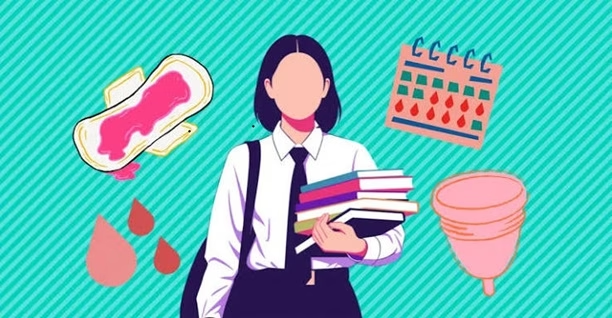
Menstruation may be a normal, healthy occurrence for girls and women of reproductive age, yet many struggle to manage their monthly period safely and hygienically, resulting in a range of adverse health, social, and educational outcomes. This is largely due to poor foundational knowledge and erroneous social beliefs about how and why menstruation occurs. Socio-cultural beliefs and taboos surrounding menstruation shape girls’ understanding to a large extent and impact how they deal with it. The deeply rooted belief that menstrual blood is dirty and impure determines how girls manage menstruation, including their choice of menstrual-absorbent hygiene practice and observance of social, religious, and food restrictions. Hence, the idea of menstrual hygiene is not limited and restricted to the usage of correct menstrual products, but it is also about shaking the belief system surrounding the idea of menses.
Article 21 and Menstrual Hygiene
A discussion on the idea of menstrual hygiene assumes significance as it is a crucial facet of the right to a healthy life as guaranteed under Article 21 of the Constitution of India. Menstruation constitutes a vital facet of a female’s health, hence cannot be ignored in the name of comfortable and affordable menstrual products; something more than mere products is required to be seen. It stands vital to look into the legal standards of menstrual hygiene mechanisms existing in India and around the globe. Since menstrual products are in great use in contemporary India, it is also crucial to look into the standards by which these products are produced, the raw materials being used, as they also form a vital part of the hygiene management process.
Article 21 is a reservoir of innumerable rights that have catered to the ever-evolving third-generation human rights. This time, the Supreme Court has expanded the horizon of Article 21 to take into its fold the right to menstrual hygiene. The idea of menstrual rights has struggled a long way from being a stigma to finally getting recognized as a fundamental right by the Custodian of the Constitution of India.
Jaya Thakur Judgement – An Evolutionary Step But A Distant Dream
The recent judgment of Dr. Jaya Thakur v. Government of India (Dr. Jaya Thakur, 2026) is on the same line of thought. The Division Bench of J.B. Pardiwala and R. Mahadevan, JJ., backed the right to menstrual hygiene with Article 21A and stated that the right to education forms a vital facet of the right to life and personal liberty. The Apex Court issued directions to all States and Union Territories to ensure adequate gender-segregated toilet and washing facilities; to foster the free availability of Jan Aushadhi Suvidha oxo-biodegradable sanitary napkins manufactured in adherence with the standards of ASTM D-6954, through sanitary napkin vending machines in the toilets; to maintain proper disposal of sanitary waste; and most importantly raise awareness about menstrual health and puberty related health concerns like PCOS, PCOD, etc., by incorporating the same in the course curricula alongside ensuring proper training and sensitization of both male and female teachers. The judgment addressed multi-directional problems surrounding the topic of menstrual health; it considered the aspect of period poverty or menstrual poverty, a situation where females face financial constraints while affording menstrual hygiene; it focused on increasing awareness about menstrual health in the classrooms to build a hesitation-free environment for girls; highlighted the progressive role of men in menstruation; and voiced importance of concrete menstrual hygiene standards to strengthen right to education for menstruating girls. But what the judgment does not talk about is the idea of WASH and the significant need for implementational reforms. The implementation of such progressive judgments needs concrete infrastructural backing, which is what is currently missing in contemporary India. Awareness about the usage of menstrual products and the availability of the same has already echoed multiple times in the social fabric through several awareness programmes, government schemes, and judgments, focusing upon the same, but the need for a strong infrastructure that supports these needs as basic human rights has not yet become the talk of the town.
The court has time and again reiterated the importance of subsidized access to menstrual hygiene products in schools, menstrual education programs, etc., like in Setu Niket v. Union of India (Setu Niket, 2017). The court also discussed the idea of menstrual poverty implicitly in Zarmina Israr Khan v. Union of India & Anr. (Zarmina Israr Khan, 2017) and Shetty Women Welfare Foundation v. Union of India (Shetty Women Welfare Foundation, 2017). Also, in the case of Mohini Jain v. State of Karnataka (Mohini Jain, 1991), the Karnataka High Court spotlighted “the link between dropout rates and menstruation,” based on the report published by the Times of India. Alongside all the above facets discussed, what we now need is a check on whether the current infrastructural flow is in line with the essence of these judgments or does it require a major set of changes.
But How Far Have We Progressed?
Dr. Jaya Thakur’s judgment, alongside many others discussed above, opens a needful discussion on the topic of menstrual hygiene being a crucial facet of Article 21 of the Constitution of India. It draws significant connections between menstrual hygiene, the progressive role of society, the role of educational institutions, employers and workplaces, the role of government, etc., but does not discuss the required infrastructural changes in the country. At this juncture, the judiciary needs to act as a watchdog as menstrual hygiene has not been pronounced as a right under Part III of the Constitution. The emphasis shall be drawn on the duty of the state, and a continuous mandamus is required to keep a check on the required developments. The judgment shall not become merely words on paper; it shall be materialized by actions.
The recent report, namely, NFHS-5 [National Family Health Survey] 2019-21 highlights developments in sanitation, showing increased access to improved facilities (like flush/septic tanks) and better menstrual hygiene (77.3% using hygienic methods), though significant gaps remain, especially in rural areas regarding open defecation (around 37%) and safe disposal of child faeces (around 49.8%), indicating ongoing challenges in achieving universal WASH (Water, Sanitation, Hygiene) goals despite policies and judgments.
Here, it stands crucial to frame a concrete WASH policy to materialize the essence of the judgment in letter and spirit. India can take inspiration from some efficient policies implemented in countrieslike Scotland, New Zealand, Kenya, Canada, Spain, and Zambia, which have taken progressive steps to strengthen menstrual health, like the removal of “tampon tax” and distribution of free menstrual products to fight period poverty; access to menstrual napkins in public buildings, libraries, and schools; implementation of state-funded menstrual leave policy for women facing severe period cramps; etc. Furthermore, the ILO’s WASH policy focuses on ensuring access to a safe and hygienic environment at workplaces through the WASH@Work Initiative, which provides a self-training handbook to raise awareness and make required workplace adjustments. This is done in line with the UN’s SDG goals 6 (water/sanitation) and 8 (decent work).
Conclusion
The recent judgment has made the right to menstrual hygiene explicitly a fundamental right, which was always implicit in the fundamental right to health. The pith and substance of the judgment revolve around the idea of WASH, alongside raising awareness amongst all generations about menstrual health. Despite menstruation as a topic gaining limelight, it remains taboo in some parts of the country. This can only be solved by grassroot awareness camps starting right from elementary levels of schooling. Both the teachers and parents need to be sensitized to bridge the information gap, which leads to fallacies, negative attitudes, shaming, bullying, and even gender-based ferocity. Education plays a crucial role here. Furthermore, in addition to the same, menstrual health can only be truly preserved by providing safe, private, and hygienic methods for females to manage their periods, including access to clean water, proper sanitary products (pads, cups, etc.), clean toilets, and information for managing products and cleaning oneself, preventing infections, boosting self-esteem, and permitting full participation in daily life. As a whole, the right to menstrual hygiene is not a stand-alone right; rather, it also encompasses the right to education and information.

Leave a Reply