
Abstract
Air pollution in India has transitioned from a seasonal environmental concern into a systemic violation of constitutional equality, where the “right to breathe” is increasingly determined by socio-economic status. While judicial interpretation has long recognised the right to a clean environment under Article 21, a significant jurisprudential gap persists regarding the disparate impact of atmospheric toxicity on marginalised groups. This article argues that air pollution is not merely an ecological problem but a profound crisis of inequality. Vulnerable populations, including children, the elderly and informal workers, endure a disproportionate health burden while the State’s responses often protect the privileged at the cost of the vulnerable. The human toll is staggering, with air pollution linked to approximately 2.1 million premature deaths annually in India. By synthesising the recent landmark M.K. Ranjitsinh (2024) ruling with the principle of environmental justice, this post contends that the failure to provide equitable respiratory security violates the constitutional promises warranted by Articles 14 and 21. Ultimately, clean air in India has been degraded into a commodity for the affluent, leaving the fundamental “Right to Life” as a hollow abstraction for millions of citizens choking under a canopy of toxic neglect.
I. The Divided Air: India’s Environmental Crisis
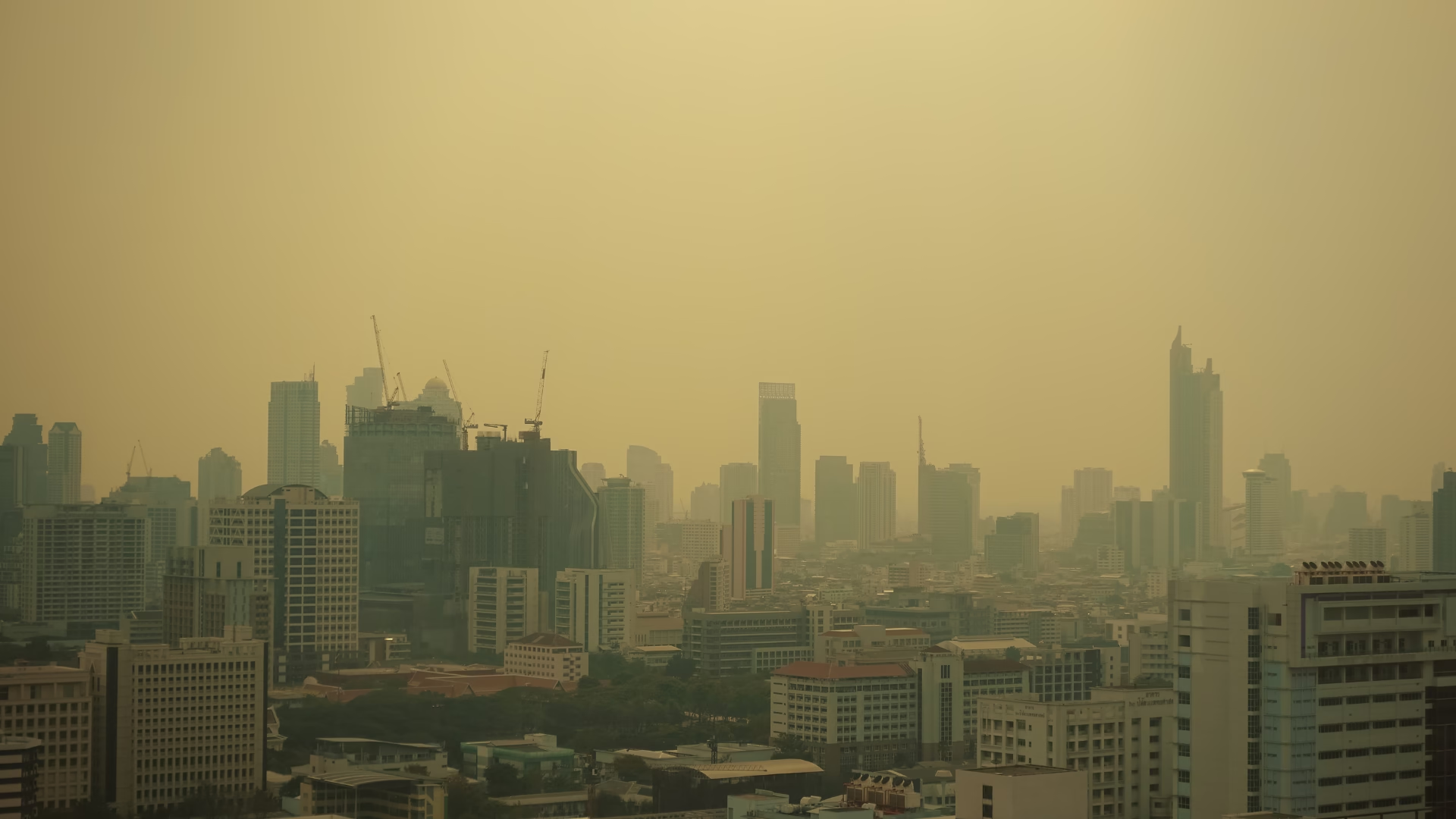
The Republic of India is currently enduring a protracted “airpocalypse” that represents one of the gravest human rights challenges of the twenty-first century, as the transition of the atmosphere from a shared natural commons to a localised health hazard challenges contemporary constitutional theory [Atmospheric Constitutionalism and the Fiduciary State (2025)]. In late 2024 and throughout 2025, air pollution in the National Capital Region (NCR) reached such extreme levels that monitoring stations recorded an Air Quality Index (AQI) of 1500, solidifying the region’s status as a global epicentre of toxic exposure [Atmospheric Governance and the Systemic Crisis of Air Quality in India (2025)]. This public health emergency is reflected in staggering data indicating that air pollution contributes to over two million premature deaths annually across the nation [HEI, State of Global Air 2024]. The human cost of this failure is catastrophic, as air pollution serves as a primary driver of non-communicable diseases and acute respiratory crises [The Architecture of Respiratory Security (2025)].
Furthermore, particulate matter exposure is estimated to reduce the average life expectancy of Indian citizens by approximately 5.3 years [CREA, Tracing the Hazy Air 2025]. However, the impacts of this atmospheric degradation are not “neutral” or evenly distributed across the population, as air quality has transitioned into a core pillar of international health security and a foundational human right [PLOS ONE: Legal implications of the climate-health crisis]. Hazardous air disproportionately affects low-income communities and marginalised groups who often live near “pollution hotspots” or lack the resources for private protection, such as high-quality housing and air filtration [Gregg Macey & Sue Dexter, Goods Movement and Environmental Justice Policy Pathologies (2025)]. Despite the magnitude of this crisis, the Indian legal response remains characterised by “derivative justiciability,” where clean air is treated as an ancillary subset of the right to life under Article 21, rather than a standalone entitlement linked to equality guarantees [Shibani Ghosh, Reforming the Liability Regime for Air Pollution in India (2015)]. Clean air in India has become a privilege, not a right, representing a “generational theft” from the country’s youth and marginalised [Mary Christina Wood, Atmospheric Trust Litigation (2009)].
II. Disproportionate Risks: Vulnerable Groups Breathe Worse
The poor, children, the elderly and informal workers significantly suffer worse from air pollution than their affluent counterparts due to both physiological and spatial vulnerabilities [(PDF) Climate Change-Induced Health Crises]. This “physiological inequality” is driven by unique biological and social factors that the State has a non-derogable duty to address [WHO: Health risks of air pollution].
- Children: The Stunted Future. Children are at a uniquely critical developmental stage where chronic exposure to polluted air results in stunted lung growth, reduced lung function, and a lifelong elevation in the risk of non-communicable diseases [Children, climate change and environmental degradation]. Recent data suggests that children’s IQ can plummet by almost 20 points in highly polluted regions, marking a direct assault on their developmental rights [Health Policy Watch: Impact on Children’s IQ].
- The Elderly: The Heat-Pollution Nexus. For the elderly, the synergy between stagnant air masses and rising winter temperatures creates a deadly “heat-pollution nexus” that elevates the risk of cardiovascular collapse [City of Lakewood, Local Hazard Mitigation Plan (2025)]. The body’s ability to maintain homeostasis is severely compromised when extreme heat meets severe toxicity, an event becoming more frequent as climate change accelerates [(PDF) Climate Change-Induced Health Crises].
- Informal Workers: Spatial Injustice. Marginalised urban populations are often trapped in “pollution hotspots” near industrial clusters or high-traffic corridors, lacking the air filtration systems that provide a shield for the wealthy [Gregg Macey & Sue Dexter, supra]. Migrant labourers and daily wagers endure a double burden; they are the primary victims of toxic exposure while bearing the economic brunt of seasonal construction bans that strip them of their subsistence [ANI News: Orders for workers hit by construction ban].
III. Policy Bias: How Measures Favour the Wealthy
Current state responses frequently protect the interests of the privileged while placing the heaviest sacrifices on those living on the margins, transferring institutional responsibility to individual innovation [India’s Air Pollution Emergency—A Comprehensive Evidence-Based Action Plan (2025)]. Judicial monitoring has revealed a policy bias where the primary contributors to pollution, the affluent class, remain resistant to changing their emission-intensive lifestyles. At the same time, state emergency measures focus on halting the activities of the poor [Abraham Thomas, Supreme Court on enforced orders (2025)].
The amicus curiae in the M.C. Mehta case recently flagged that even when the court orders sports activities to be halted during severe smog, private institutions often find ways to bypass the orders, while the urban poor have no choice but to face the elements [Namrata Banerjee, Delhi Air Pollution Crisis (2025)]. Furthermore, institutional failures exacerbate this divide:
- Financial Negligence: Approximately two-thirds of National Clean Air Programme (NCAP) funding remains unused in major cities due to administrative sluggishness and bureaucratic delays [Oommen C. Kurian, ‘No Conclusive Data’ Headlines, ORF (2025)].
- Cosmetic Mitigation: NCAP funds are often directed toward “cosmetic” urban measures like road sweeping, while less than one percent of funding targets toxic industrial emissions that ravage low-income settlements [Reforming India’s Air-Quality Governance (2025)].
- Legislative Apathy: In late 2025, a critical discussion on the air crisis in Parliament was cancelled because the “environment in the House was not congenial” for discussion [India Today: Winter Session ends without discussion].
- Rejection of Science: The Union Health Ministry has repeatedly attempted to understate risks, claiming there is “no conclusive data” linking air pollution to mortality, a stance experts describe as a “rejection of science” that undermines the lived reality of millions [The Wire: Govt rejecting data and science].
IV. A Constitutional Breach of Equality and Dignity
This lopsided governance directly violates the constitutional promise of equality (Article 14) and human dignity (Article 21) [India’s New Constitutional Climate Right, Verfassungsblog (2024)]. Historically, the judiciary interpreted Article 21 to include the “right of enjoyment of pollution-free air” [Subhash Kumar v. State of Bihar (1991)]. However, the 2024 landmark ruling in M.K. Ranjitsinh v. Union of India took a monumental leap by explicitly anchoring the right against the adverse effects of climate change in both Article 21 and Article 14 [M.K. Ranjitsinh v. Union of India (2024)].
The Court in Ranjitsinh observed that “the inability of underserved communities to adapt to climate change or cope with its effects violates the right to life as well as the right to equality” [Maya Nirula, Pioneering Decision from the Indian Supreme Court (2024)]. When the state fails to effectively regulate hazardous AQI, it permits a discriminatory environment where respiratory health is a commodity that can be purchased by the rich, while the poor are left with “no conclusive data” to justify their suffering. Such a scenario mocks the mandate of Article 21, which includes the right to live in a pollution-free environment as an essential attribute of a life with dignity. By treating toxic air as a peripheral administrative matter rather than a core equality violation, the State abdicates its fiduciary duty under the Atmospheric Trust Doctrine, which posits that the atmosphere is a vital natural asset held in trust by the State for all citizens [Jenna Lewis, In Atmosphere We Trust (2019)].
V. Securing Breath: Enforceable Legal Standards
To secure the right to clean air for all, Indian environmental jurisprudence must move from reactive crisis management to a robust, rights-based system of atmospheric governance [Towards Operationalising a New Climate Right for India, The India Forum (2026)].
- Emergency shutdowns: A justiciable right must be supported by a provision that remove political and administrative hesitation during toxic spikes. Drawing on nuclear safety protocols, the law should mandate emergency shutdowns the moment PM 2.5 exceeds specific scientific thresholds [India’s Air Pollution Emergency Action Plan, supra].
- Strict Scrutiny: Judicial review must apply strict scrutiny when State actions cumulatively impair the atmosphere, particularly those affecting vulnerable communities [Richard Delgado, Active Rationality in Judicial Review (1979)]. Under this standard, any State action that increases the pollution load in a community already suffering from “Very Poor” AQI must be held accountable without exception [Atmospheric Constitutionalism and the Fiduciary State, supra].
- Continuing Mandamus: The judicial tool of Continuing Mandamus must evolve from seasonal micromanagement to a system of structural transition monitoring [Manoj Mate, The Rise of Judicial Governance in the Supreme Court of India (2015)]. Courts should oversee the State’s progress toward region-wide airshed management and data transparency mandates [National Air Quality Governance in India (2025)].
VI. Conclusion
The current approach to air quality in India is like a sinking ship where only the first-class passengers are provided with life vests and oxygen masks. While the authorities focus on “polishing the deck” to satisfy the privileged contributors to the crisis, the water of toxicity continues to drown those trapped in the lower decks who have neither the data to prove their suffering nor the means to escape it. Until breath is de-commodified, the Indian Constitution remains gasping for air.Ultimately, clean air in India has been degraded into a privilege, not a right. The latest events of 2024-2025 demonstrate that atmospheric safety can no longer be a matter of executive discretion or seasonal optics; it must be a “constitutional mandate” triggered by objective scientific benchmarks [CREA, Tracing the Hazy Air 2025, supra]. The transition to a justiciable “Right to Breathe” is not merely a legal necessity but a moral imperative to protect the dignity of millions who currently live on the margins as “ecosystem refugees” [(PDF) Climate Change-Induced Health Crises, supra]. Only when the law functions as a proactive shield for the most vulnerable can India fulfil the democratic promise of equality and life.

Leave a Reply