
Abstract
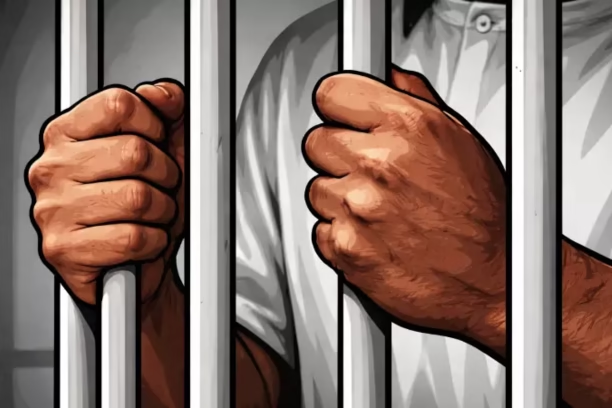
Indian courts often say that “bail is the rule and jail is the exception.” But if this is true, why are more than 75% of India’s prisoners undertrials, people who have not been convicted of any crime? This article asks this simple but uncomfortable question. Using a Critical Legal Studies perspective, the author examines how the legal system creates so much imprisonment even while claiming that bail is the normal rule. By referring to the Bharatiya Nagarik Suraksha Sanhita, 2023, the Prevention of Money Laundering Act, 2002, the Supreme Court decisions in Satender Kumar Antil and Vijay Madanlal Choudhary, and prison statistics, the author demonstrates that the regime of Indian bail law often acts as a narrative story, justifying and masking class, caste and economic disparities through neutral legal rhetoric. The article also argues that the BNSS 2023 does not truly protect accused persons’ liberty. Instead, it increases the State’s power to keep people in custody. Therefore, Indian bail law needs real structural reform, not just important Supreme Court judgments.
The Promise and the Reality
In Indian criminal law, students often hear the line: “bail is the rule, jail is the exception.” The Supreme Court gave this principle in State of Rajasthan v. Balchand, and later repeated it in many cases, including Satender Kumar Antil v. CBI.
But the actual prison figures tell a different story. The percentage of undertrial prisoners in India in the year 2023 was 75.8% of total prisoners in Indian jails. That is, 3,89,910 persons are in jail but their trial in court is ongoing and they are not found guilty yet. Most of these undertrial prisoners are from weak social or economical groups. Out of them, 80,192 were from Scheduled Castes, 38,987 from Scheduled Tribes, and 1,37,665 from Other Backward Classes. If bail was really working as the normal rule, such a large undertrial population would not exist. Yet it does. This gap between the promise of law and the reality of prison life is exactly what Critical Legal Studies helps us examine.
What is Critical Legal Studies?
Critical Legal Studies, or CLS, is not a complicated theory. It mainly says that law is not always neutral. Legal rules may look fair and objective, but many times they reflect political and social choices. CLS also argues that law often supports existing power by presenting these choices as logical and fair, making inequality appear normal or unavoidable. It further says that rights do not work in the same way for everyone. The real meaning of a right depends on who is using it, who is applying it, and the social situation in which it is applied.
When we apply this idea to bail, we understand that the principle “bail is the rule” does not always give real freedom to accused persons. Instead, it often works like a story told by the legal system, which hides the deeper structural problems in bail law.
The Architecture of Discretion: The Politics of Inequality
Section 480 of the Bharatiya Nagarik Suraksha Sanhita, 2023, which replaces Section 437 of the CrPC, gives a Magistrate the power to grant bail in non-bailable offences. However, it also tells the Magistrate to refuse bail if there are “reasonable grounds” to believe that the accused has committed an offence punishable with death or life imprisonment. The problem is that the law does not clearly define what “reasonable grounds” means. As a result, wide discretion is granted to the judges. Critical Legal Scholars, such as Duncan Kennedy point to the reality that such discretion allows personal biases, presumptions, and beliefs within the socio-legal context, to seep into the justice system.
Section 483 of the BNSS gives broader bail powers to the Sessions Court and the High Court. This creates a hierarchy. The Magistrate is described as the severest gatekeeper initially, whereas the High Court possesses a more liberal authority to grant bail. However, gaining access to the High Court requires capital, knowledgeable attorneys, travel expenses, paperwork, and time. Rich accused persons can access these higher courts more easily. Poor and marginalised accused persons often remain stuck before the Magistrate, where bail discretion is narrower and the prosecution has stronger influence.
The same problem appears in the language used in bail hearings. Arguments such as the “gravity of the offence,” the “possibility of absconding,” and “the chance of witness tampering” are invariably considered. The phrases: ‘gravity of the offense’, ‘possibility of absconding,’ ‘chance of witness tampering,’ do not hold absolute meanings, rather, a well-endowed defendant could easily prove the absence of the aforesaid criteria. By producing proof of the existence of assets, family ties, socio-economic status, occupation, or submission of a passport to the Court, a sophisticated defence could easily sway any of the factors that would potentially militate against the granting of bail. These facts make the accused look stable and trustworthy before the court.
On the other hand, poor undertrials may not have property, permanent employment, or strong legal representation. Many depend on overburdened legal aid lawyers who handle too many cases at once. Their applications could consequently be dismissed without a detailed explanation but often through a brief “application dismissed” order. Both situations use the same law but the outcomes become radically dissimilar. This difference is not accidental. It shows how the structure of bail law produces inequality.
The BNSS 2023: Reform That Widens the Gap
The Bharatiya Nagarik Suraksha Sanhita, 2023 was introduced as a step away from colonial criminal laws. However, one important change in the BNSS increases the power of the police instead of protecting personal liberty. Under the old CrPC, Section 167(2), as explained in CBI v. Anupam J. Kulkarni, allowed police custody only within the first fifteen days of remand. After this period, the accused could be kept only in judicial custody. This rule worked as a safeguard because it limited the time during which the police could directly control and question an accused person.
Section 187 of the BNSS changes this safeguard. It allows the police to take fifteen days of police custody in parts, at any time during the first forty or sixty days of remand, depending on the offence. This gives investigating agencies more control over the timing of custody. They can now ask for police custody later in the investigation, when it may be more useful for them. For example, they may seek custody when important witnesses are being examined or when key documents are being collected. In practice, this can increase pressure on the accused and keep the person under fear of police custody for a longer time.
This change also affects the idea of default bail under Section 479 of the BNSS. Because police custody can be distributed over an extended period of remand, pre-trial detention may last longer. This creates grave concerns under Article 21 and 22 of the Constitution regarding personal liberty and arrest-related safeguards. This issue was considered by the Supreme Court in Hussainara Khatoon v. State of Bihar in which it included speedy trial within the Fundamental Rights of accused, and then, in Sanjay Chandra v. CBI , by stating that, “pre-trial detention must not be used as a punishment for the alleged offense before conviction”.
From a Critical Legal Studies view, this shows that reform does not always mean freedom. The BNSS uses the language of decolonisation, but it keeps the old colonial habit of controlling the accused person’s body. The prison and custody system still carries the legacy of the Prisons Act, 1894. So, the law changes its name, but the structure of State control remains largely the same.
Special Laws and the Inversion of Innocence: The PMLA Story
The Twin Conditions
Section 45 of the PMLA creates strict “twin conditions” for bail. First, the court must hear the Public Prosecutor. Secondly, the Court must be satisfied that the accused is not guilty and is not likely to commit an offense while on bail. In simpler words, the court should believe from the bail stage that the accused is probably innocent. This reverses the normal idea of criminal law, where the State must prove guilt. Under PMLA, the accused carries a heavy burden even before trial begins.
The Nikesh to Vijay Madanlal Arc
These two conditions were struck down by the Supreme Court in Nikesh Tarachand Shah v. Union of India for being inconsistent with the Constitution under Articles 14 and 21. However, the Parliament introduced these two conditions in the PMLA in 2018 and later the amended conditions were validated by the Supreme Court in Vijay Madanlal Choudhary v. Union of India. The Court accepted the government’s argument that money laundering is a serious and transnational offence and therefore needs special treatment.
This journey shows an important Critical Legal Studies point: rights do not remain fixed. The Court first recognised the accused’s bail right, Parliament then reduced it, and the Court later approved that reduction. So, the right to liberty became the result of a struggle between institutions, not a guaranteed protection for the accused.
The ECIR Problem
The PMLA system creates another serious problem through the ECIR, or Enforcement Case Information Report. After Vijay Madanlal, the ECIR remains an internal document of the Enforcement Directorate and does not have to be given to the accused. This means the accused must prove possible innocence without fully knowing the case built by the State.
This is not a small procedural issue. It weakens due process itself. Later cases like V. Senthil Balaji v. State and Prem Prakash v. Union of India tried to reduce the harshness of this rule, but they did not fully reverse it. Therefore, PMLA bail law changes the basic balance between the State and the accused.
Bail as a Reflection of the Society
The Surety Trap
While bail may be granted on many occasions, the accused may not walk out of jail due to one simple reason: inability to procure a surety. A surety is a person held ‘responsible’ by the court, and makes a promise that the accused would present himself on the next date. The surety risks forfeit of money or property should the accused fail to appear. For poor people, migrants, daily wage earners, and tribal persons living far from the court, finding such a person is extremely difficult. So, the bail order exists, but liberty does not. The court may say that it has followed the rule, yet the person remains inside prison. This shows that bail law ignores the social and economic conditions on which freedom actually depends.
The Geography of Liberty
Bail also depends heavily on location. There are different stages of the criminal proceeding namely, Magistrate, Sessions Court, High Court and Supreme Court. But all these forum are not available and accessible equally to all. The tribal undertrial of an interior village of Jharkhand or Chhattisgarh will not have the same kind of exposure of the system as the accused person in Delhi or Mumbai. The High Court might be far away, the travelling expenses can be high and the competent lawyer who is able to effectively argue the cases like that of Satender Kumar Antil can be unattainable. For such prisoners, Supreme Court judgments may exist in law reports, but not in their everyday reality. This geographical inequality is often ignored in ordinary discussions on bail.
The Legal Aid Illusion
Article 39A promises free legal aid, and the Legal Services Authorities Act, 1987 creates a system for it. But the ground reality is very different. Legal aid lawyers often deal with too many cases, receive low fees, and sometimes get the file only shortly before the matter is called. A bail plea argued in this situation cannot be compared with one argued by a senior lawyer before a High Court. On paper, both accused persons have legal representation. In practice, the quality and impact of that representation are very different. This is exactly what Critical Legal Studies points out: rights may exist in law, but the way they operate can still reproduce inequality.
The Satender Kumar Antil Paradox
Satender Kumar Antil v. CBI is an important judgment and deserves recognition. In this case, the Supreme Court divided offences into different categories according to the maximum punishment. It also said that investigating agencies should not arrest accused persons unnecessarily, especially when they are cooperating with the investigation. The Court issued these directions to reduce the number of undertrial prisoners and to make bail more accessible.
However, the real problem appears after the judgment. In 2023, the Supreme Court had to pass compliance orders and ask the Allahabad and Jharkhand High Courts to check whether lower courts were actually following these directions. This itself shows that even a strong Supreme Court judgment does not automatically change the working of the criminal justice system.
This creates the main Critical Legal Studies question: why does a 2022 judgment need monitoring in 2023 and 2024? The answer is that the judgment works inside the existing system, it does not change the system itself. An accused person can benefit from Satender Kumar Antil only if a lawyer knows the judgment, raises it properly, and the court is willing to apply it. Many undertrials may remain in jail for months before anyone even files such an application for them.
This is the paradox of Satender Kumar Antil. Every time the Supreme Court gives a judgment in favour of liberty, it also strengthens the belief that the system can correct itself. The judgment shows that the Court cares about freedom, but the same system continues to produce a huge undertrial population. So, the problem is not the judgment itself. The problem lies in expecting judgments alone to solve deep structural issues. If the ground conditions remain unchanged, even progressive judgments become limited relief for a few, not real freedom for all.
What Structural Reform Would Look Like, Truly
If bail failure comes from the structure of the system, then the answer must also be structural. One more Supreme Court judgment will not be enough. The system needs changes that work in ordinary courts, police stations, and prisons, especially for undertrials who do not have money, influence, or strong legal support.
The first reform should be automatic bail review. Every undertrial who has remained in jail for more than 90 days without a charge-sheet should have their case placed before the court for bail review. The prisoner should not be expected to file a fresh application. Instead, the State should explain why continued detention is necessary. This idea was also suggested in the 3rd Law Commission Report. Such a rule would make the State justify jail, rather than making the accused fight for liberty.
The second reform should deal with surety. Many accused persons receive bail orders but still remain in jail because they cannot arrange a surety. For accused persons below a fixed income level, courts should normally accept a personal bond instead of demanding surety. A personal bond is only a written promise that the accused will appear in court. Section 479 of the BNSS already allows this, but in practice it remains underused because it depends on lawyers, applications, and the judge’s discretion.
The third reform must strengthen legal aid. Lawyers should be assigned from the time of arrest, not only when the accused first appears in court. They should also receive case papers before the hearing. Otherwise, legal aid becomes a formality. A lawyer who sees the file at the last minute cannot properly argue bail.
The fourth reform concerns the PMLA. Parliament should reconsider the twin conditions under Section 45, because they make bail extremely difficult by asking the accused to show probable innocence. The ECIR process should also become more transparent. At the minimum, the authorities must clearly provide the grounds of arrest, as Article 22(1) requires. Without these changes, bail will remain a promise for many and a reality only for a few.
Conclusion: The Rule That Produces the Structure
“Bail is the rule, jail is the exception” is not a false principle. Courts have repeated it many times, and it remains an important part of Indian criminal law. But the real problem lies in the structure that surrounds this rule. In the everyday, the system ends up generating more jail than bail for poor, socially marginalized groups, migrants and others who are without money, social networks or legal knowledge to navigate the system.
The BNSS 2023 could have corrected this imbalance, but it missed that chance. Instead of reducing custody, Section 187 increases police power by allowing police custody to be used in parts over a longer period. Similarly, the Vijay Madanlal framework under the PMLA strengthens strict bail conditions and places a heavy burden on the accused. These developments show that the law often expands State power while still speaking the language of liberty.
Judgments like Satender Kumar Antil are important, but they also show the limits of judge-made reform. If a Supreme Court judgment needs repeated monitoring to ensure that lower courts follow it, then the problem is deeper than interpretation. The issue lies in everyday legal practice.
Critical Legal Studies asks us to look past attractive sounding legal words and find how the system actually operates in real terms. Bail involves surety, money, legal aid, caste, class and geographical distance. Unless these structural barriers change, “bail is the rule” will remain a promise that many accused persons hear, but never truly receive.

Leave a Reply